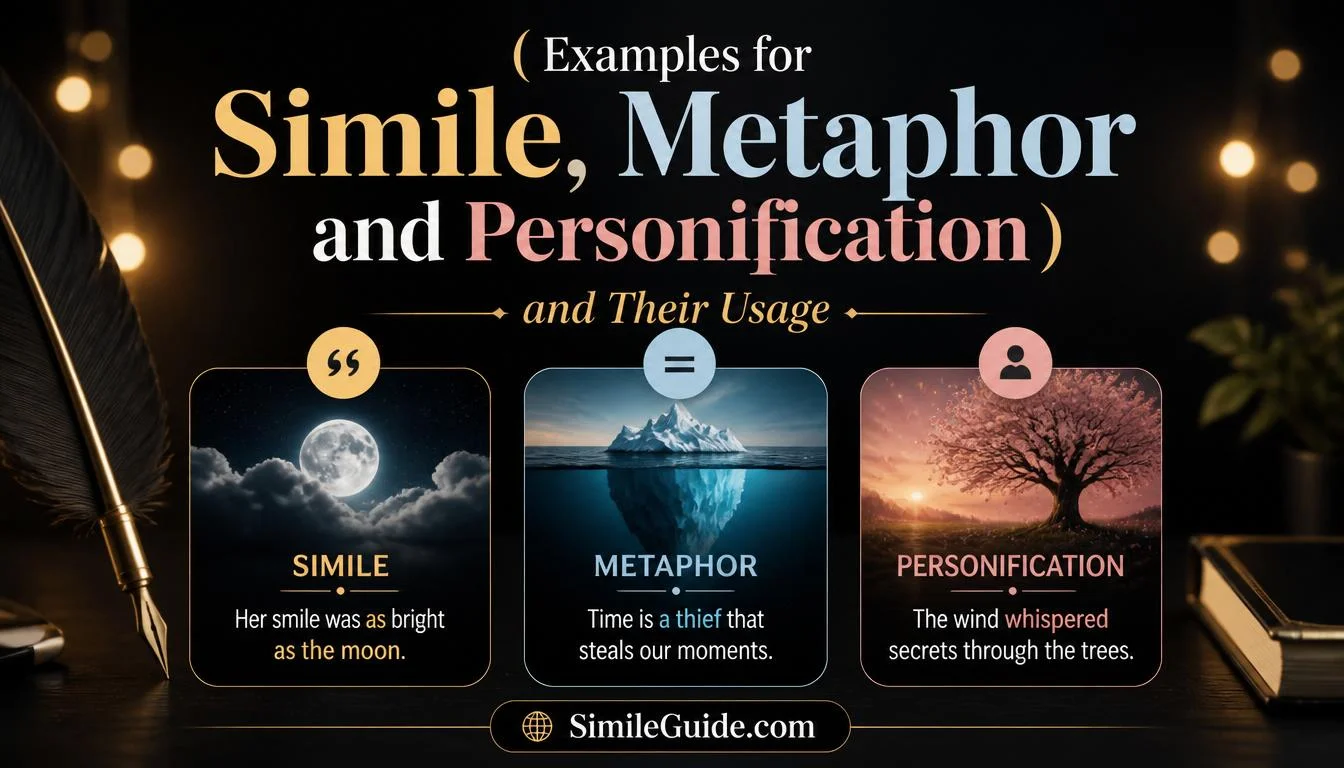
Figurative language makes writing more colorful, engaging, and memorable. Three of the most common literary devices are similes, metaphors, and personification. They help readers imagine scenes, understand emotions, and enjoy stories in a more creative way.
Whether you’re a student learning English, a writer improving your skills, or a reader searching for quick explanations, understanding examples for simile, metaphor, and personification will make your writing stronger. Updated for 2026, this guide explains each literary device in simple words and provides practical examples you can use in essays, poems, speeches, captions, and everyday conversations.
In everyday conversations, people often use similes, metaphors, and personification without realizing it. From real-life writing experience, these figures of speech make ordinary sentences more vivid and interesting.
What Are Examples for Simile, Metaphor, and Personification?
Definition in Simple Words
A simile compares two different things using “like” or “as.”
Example: Her smile was like sunshine.
A metaphor compares two things directly without using “like” or “as.”
Example: Her smile was sunshine.
Personification gives human qualities to animals, objects, or ideas.
Example: The wind whispered through the trees.
Each literary device helps readers picture ideas more clearly and adds emotion to writing.
How Similes, Metaphors, and Personification Work
Understanding the Differences
Although all three create vivid descriptions, they work differently.
- Similes compare using like or as.
- Metaphors make direct comparisons.
- Personification makes non-human things behave like people.
Learning these differences makes it easier to identify and create figurative language.
Why Writers Use These Literary Devices
Making Writing More Interesting
Writers use similes, metaphors, and personification to describe:
- People
- Nature
- Emotions
- Weather
- Animals
- Objects
- Places
- Ideas
These literary devices help readers imagine scenes instead of simply reading facts.
Examples in Everyday Life
Where You Can Use Them
These figures of speech are useful in:
- School essays
- Poems
- Stories
- Speeches
- Social media captions
- Greeting cards
- Blog posts
- Daily conversations
Instead of writing:
“The room was quiet.”
You could write:
- The room was as quiet as a library. (Simile)
- The room was a silent cave. (Metaphor)
- Silence wrapped its arms around the room. (Personification)
1. Bright Smile
Meaning
Describes someone with a cheerful, glowing smile.
Examples
Simile: Her smile was like sunshine on a spring morning.
Metaphor: Her smile was sunshine.
Personification: The smile welcomed everyone into the room.
2. Fast Runner
Meaning
Shows great speed.
Examples
Simile: He ran like the wind.
Metaphor: He was a racing arrow.
Personification: The road encouraged him to run faster.
3. Heavy Rain
Meaning
Describes strong rainfall.
Examples
Simile: The rain fell like buckets of water.
Metaphor: The rain was a waterfall from the sky.
Personification: The rain danced across the rooftops.
4. Calm Ocean
Meaning
Represents peace and stillness.
Examples
Simile: The ocean was as calm as glass.
Metaphor: The ocean was a mirror.
Personification: The ocean smiled beneath the morning sun.
5. Bright Stars
Meaning
Shows sparkling beauty.
Examples
Simile: The stars shone like diamonds.
Metaphor: The stars were diamonds scattered across the sky.
Personification: The stars winked at the travelers.
6. Busy City
Meaning
Describes an active place.
Examples
Simile: The city buzzed like a beehive.
Metaphor: The city was a living machine.
Personification: The city never slept.
7. Gentle Breeze
Meaning
Represents soft wind.
Examples
Simile: The breeze felt like a soft feather.
Metaphor: The breeze was a gentle hand.
Personification: The breeze whispered through the trees.
8. Strong Friendship
Meaning
Shows loyal friendship.
Examples
Simile: Their friendship was like a sturdy bridge.
Metaphor: Their friendship was an unbreakable chain.
Personification: Friendship held them together through every challenge.
9. Loud Thunder
Meaning
Represents powerful sound.
Examples
Simile: The thunder roared like a lion.
Metaphor: The thunder was a giant drum.
Personification: The thunder shouted across the sky.
10. Happy Child
Meaning
Describes great happiness.
Examples
Simile: The child was as happy as a bird in flight.
Metaphor: The child was pure joy.
Personification: Happiness danced in the child’s eyes.
11. Tall Tree
Meaning
Shows great height and strength.
Examples
Simile: The tree stood like a giant.
Metaphor: The tree was a tower.
Personification: The tree stretched its arms toward the sky.
12. Bright Moon
Meaning
Represents beauty and light.
Examples
Simile: The moon shone like a silver coin.
Metaphor: The moon was a glowing lantern.
Personification: The moon smiled over the quiet village.
13. Hot Sun
Meaning
Describes intense heat.
Examples
Simile: The sun burned like fire.
Metaphor: The sun was a blazing furnace.
Personification: The sun greeted everyone with warm rays.
14. Colorful Garden
Meaning
Shows natural beauty.
Examples
Simile: The garden looked like a rainbow.
Metaphor: The garden was a living painting.
Personification: The flowers smiled at every visitor.
15. Flowing River
Meaning
Represents smooth movement.
Examples
Simile: The river flowed like silk.
Metaphor: The river was a silver ribbon.
Personification: The river sang as it passed through the valley.
More Examples for Simile, Metaphor, and Personification
Learn with 25 More Easy Examples
The following examples help you understand the difference between simile, metaphor, and personification. Each topic includes a bold meaning followed by one example of each literary device.
16. Snow
Meaning
Describes the beauty and softness of falling snow.
Simile: The snow fell like soft feathers from the sky.
Metaphor: The snow was a white blanket covering the earth.
Personification: The snow kissed the mountaintops gently.
17. Fire
Meaning
Represents heat, power, and energy.
Simile: The flames danced like excited children.
Metaphor: The fire was a hungry beast.
Personification: The fire reached toward the sky with eager hands.
18. School
Meaning
Shows learning and opportunity.
Simile: The school was like a busy beehive.
Metaphor: The school was a gateway to success.
Personification: The classroom welcomed every student with open arms.
19. Book
Meaning
Represents knowledge and imagination.
Simile: The book was like a doorway to another world.
Metaphor: The book was an endless adventure.
Personification: The pages whispered amazing stories.
20. Clock
Meaning
Shows the passing of time.
Simile: Time moved like a flowing river.
Metaphor: Time was a thief.
Personification: The clock reminded everyone to hurry.
21. Mountain
Meaning
Represents strength and greatness.
Simile: The mountain stood like a mighty king.
Metaphor: The mountain was Earth’s crown.
Personification: The mountain watched over the valley.
22. Forest
Meaning
Describes mystery and beauty.
Simile: The forest was like a green maze.
Metaphor: The forest was nature’s cathedral.
Personification: The trees welcomed every traveler.
23. Butterfly
Meaning
Represents beauty and freedom.
Simile: The butterfly floated like a colorful leaf.
Metaphor: The butterfly was a flying rainbow.
Personification: The butterfly greeted every flower.
24. Ice
Meaning
Shows coldness or emotional distance.
Simile: His hands were as cold as ice.
Metaphor: His heart was ice.
Personification: The ice hugged the frozen lake tightly.
25. Wind
Meaning
Describes movement and sound.
Simile: The wind raced like a wild horse.
Metaphor: The wind was an invisible dancer.
Personification: The wind sang through the trees.
26. Night
Meaning
Represents darkness and peace.
Simile: The night was as black as ink.
Metaphor: The night was a velvet curtain.
Personification: The night wrapped the town in silence.
27. Flower
Meaning
Shows beauty and freshness.
Simile: She was as beautiful as a blooming flower.
Metaphor: She was a rose in the garden.
Personification: The flowers waved to every passerby.
28. River
Meaning
Represents smooth movement.
Simile: The river flowed like melted silver.
Metaphor: The river was a shining ribbon.
Personification: The river laughed over the rocks.
29. Sky
Meaning
Describes beauty and openness.
Simile: The sky was like a blue ocean above us.
Metaphor: The sky was a giant canvas.
Personification: The sky smiled after the storm.
30. Rain
Meaning
Represents gentle or heavy rainfall.
Simile: The rain fell like tiny pearls.
Metaphor: The rain was a silver curtain.
Personification: The rain tapped gently on the windows.
31. Sun
Meaning
Shows brightness and warmth.
Simile: The sun shone like a golden coin.
Metaphor: The sun was a glowing torch.
Personification: The sun smiled across the morning sky.
32. Ocean
Meaning
Represents size and power.
Simile: The ocean stretched like endless blue silk.
Metaphor: The ocean was a giant mirror.
Personification: The ocean called to the sailors.
33. Bird
Meaning
Shows freedom and happiness.
Simile: She sang like a bird.
Metaphor: She was a songbird.
Personification: The bird welcomed the sunrise with music.
34. Smile
Meaning
Represents kindness and happiness.
Simile: His smile was like the morning sun.
Metaphor: His smile was sunshine.
Personification: The smile brightened the room.
35. Road
Meaning
Represents life’s journey.
Simile: Life is like a long road.
Metaphor: Life is a winding road.
Personification: The road invited us to explore.
36. Stars
Meaning
Shows beauty and brilliance.
Simile: The stars sparkled like diamonds.
Metaphor: The stars were jewels in the sky.
Personification: The stars winked at the campers.
37. Tree
Meaning
Represents strength and growth.
Simile: The tree stood like a soldier.
Metaphor: The tree was a guardian of the forest.
Personification: The tree stretched its branches toward the sun.
38. Morning
Meaning
Represents a fresh beginning.
Simile: Morning arrived like a gentle whisper.
Metaphor: Morning was a fresh start.
Personification: Morning greeted everyone with golden light.
39. Love
Meaning
Represents deep affection.
Simile: Love is like a beautiful garden.
Metaphor: Love is a flame.
Personification: Love knocked softly on their hearts.
40. Hope
Meaning
Represents optimism and encouragement.
Simile: Hope is like a bright star in the night.
Metaphor: Hope is a lighthouse.
Personification: Hope guided them through difficult times.
Famous Examples
Popular Examples in Literature
Many famous writers use these literary devices:
- “As brave as a lion.” (Simile)
- “Time is a thief.” (Metaphor)
- “The wind whispered through the trees.” (Personification)
These examples remain popular because they create clear, memorable images.
Simile vs. Metaphor vs. Personification
Comparison Table
| Literary Device | Meaning | Example |
|---|---|---|
| Simile | Compares using like or as | The clouds were like cotton. |
| Metaphor | Direct comparison | The clouds were cotton. |
| Personification | Gives human qualities | The clouds hugged the mountains. |
How to Use or Create Them
Step 1: Choose Your Subject
Pick something to describe.
Step 2: Decide Which Device Fits Best
- Use Simile for easy comparisons.
- Use Metaphor for stronger imagery.
- Use Personification to bring objects to life.
Step 3: Keep It Simple
Use familiar comparisons that readers can easily imagine.
Common Mistakes People Make
Confusing Similes and Metaphors
Remember:
- Simile = like/as
- Metaphor = direct comparison
Overusing Personification
Not every object needs human actions.
Using Unclear Comparisons
Choose comparisons your audience can easily understand.
Making Figurative Language Too Complicated
Simple examples are often the most effective.
Frequently Asked Questions
What is the difference between a simile and a metaphor?
A simile uses like or as, while a metaphor makes a direct comparison.
What is personification?
Personification gives human qualities to animals, objects, or ideas.
Why are these literary devices important?
They make writing more interesting, descriptive, and memorable.
Can students use these examples in essays?
Yes. These examples are excellent for essays, speeches, creative writing, and classroom assignments.
How can I improve my figurative language?
Read regularly, practice writing your own examples, and use clear, natural comparisons.
Conclusion
Learning examples for simile, metaphor, and personification helps students and writers create vivid, engaging, and meaningful writing. These literary devices turn ordinary descriptions into memorable images that readers can easily imagine.
From real-life writing experience, the best figurative language is simple, relevant, and natural. Practice these 40+ examples in essays, poems, stories, captions, and daily conversations to build confidence and improve your writing skills.
DISCOVER MORE ARTICLES
Simile Examples for Summer: Complete Guide 2026
40+ Similes for Environment with Meanings and Examples 2026
40+ Similes for Storm Clouds with Meanings and Examples 2026
