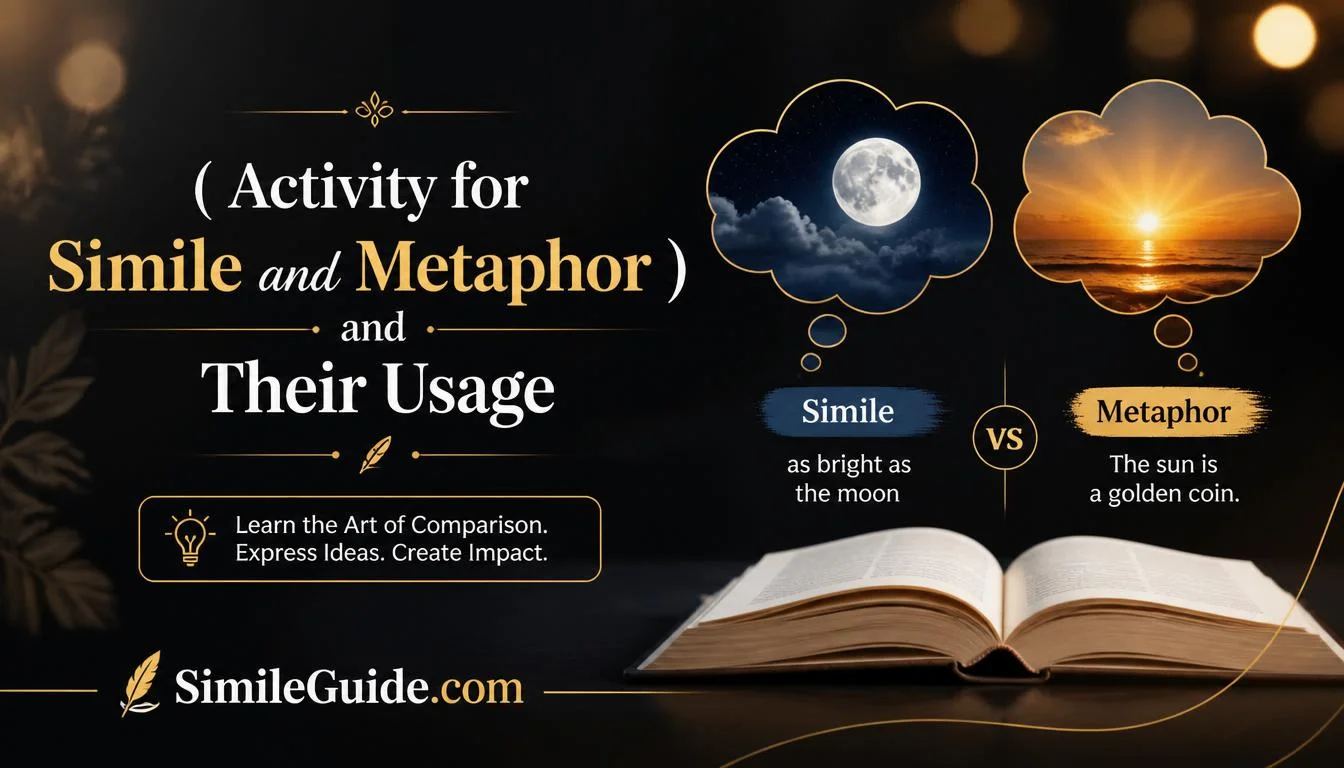
Learning figurative language doesn’t have to be boring. A well-designed activity for simile and metaphor can turn an ordinary English lesson into an exciting experience where students explore creativity, improve vocabulary, and become more confident writers.
Whether you’re a teacher planning engaging classroom lessons, a student preparing for an English assignment, or a parent helping with homework, using interactive activities makes similes and metaphors much easier to understand. Instead of memorizing definitions, learners practice using these literary devices in real situations, making the lessons meaningful and memorable.
Updated for 2026, this guide shares practical ideas, examples, and teaching strategies that work in modern classrooms, online learning environments, and even at home. By the end, you’ll have plenty of creative activities that help learners recognize, create, and confidently use similes and metaphors in essays, poems, stories, presentations, and everyday conversations.
Table of Contents
- What Is an Activity for Simile and Metaphor?
- Why Simile and Metaphor Activities Matter
- How an Activity for Simile and Metaphor Works
- Benefits of Using Simile and Metaphor Activities
- Examples of Simile and Metaphor in Everyday Life
- Getting Students Ready Before the Activities
- Activity Ideas (Part 2)
- Simile vs. Metaphor
- Common Mistakes
- FAQs
- Conclusion
What Is an Activity for Simile and Metaphor?
An activity for simile and metaphor is any learning exercise that helps students understand, identify, compare, or create similes and metaphors in a fun, interactive way.
Rather than simply reading definitions from a textbook, students actively practice figurative language through games, worksheets, storytelling, drawing, role-playing, creative writing, and group discussions.
A simile compares two different things using words like “like” or “as.”
Example:
“She is as busy as a bee.”
This compares a person’s busyness to a bee’s hardworking nature.
A metaphor compares two things by saying one thing is another.
Example:
“Time is a thief.”
This metaphor suggests that time quietly steals moments from our lives.
Both literary devices make writing more colorful, descriptive, and memorable.
Why Simile and Metaphor Activities Matter
Students often struggle to tell the difference between similes and metaphors. Interactive activities remove confusion by allowing learners to discover the concepts through practice rather than memorization.
These activities help students:
- Build stronger vocabulary
- Improve reading comprehension
- Write more descriptive essays
- Understand poetry more easily
- Develop creative thinking
- Speak with greater confidence
- Enjoy English lessons
From real-life writing experience, students remember figurative language much better after completing creative classroom activities than after reading definitions alone.
How an Activity for Simile and Metaphor Works
Most activities follow a simple learning process.
Step 1: Introduce the Concept
Explain what a simile and a metaphor are using simple examples.
Example:
- The water was as clear as glass.
- The classroom was a zoo.
Discuss why each comparison works.
Step 2: Identify Examples
Students read short sentences and decide whether each one contains a simile or a metaphor.
Example:
- “He fought like a lion.” → Simile
- “He is a lion in battle.” → Metaphor
This strengthens recognition skills.
Step 3: Create Original Comparisons
Students write their own similes and metaphors using everyday objects or experiences.
Examples:
- My backpack is as heavy as a mountain.
- Homework is a marathon.
Creating original examples encourages imagination.
Step 4: Share and Discuss
Students present their work to classmates.
Class discussions allow learners to explain why their comparisons are effective and receive helpful feedback.
Benefits of Using Simile and Metaphor Activities
An engaging activity for simile and metaphor offers benefits beyond grammar lessons.
Improves Creative Writing
Students learn to paint vivid pictures with words instead of relying on simple descriptions.
Makes Reading Easier
Many novels and poems contain figurative language. Practice activities help students recognize these expressions quickly.
Encourages Critical Thinking
Students think about similarities between unrelated ideas, strengthening analytical skills.
Builds Speaking Confidence
In everyday conversations, people often use activity for simile and metaphor exercises to become more comfortable with expressive language, making their speech more interesting and engaging.
Increases Classroom Participation
Games, competitions, and group challenges encourage even quiet students to participate.
Examples of Simile and Metaphor in Everyday Life
Figurative language isn’t limited to literature. We hear it every day.
At School
Teacher:
“Your classroom is a library today.”
The classroom isn’t literally a library. The metaphor means everyone is very quiet.
During Sports
Coach:
“Run like the wind!”
The simile encourages players to run extremely fast.
At Home
Parent:
“Your room is a disaster zone.”
This metaphor humorously describes a messy room.
On Social Media
People often write captions such as:
- Life is a journey.
- Smile like sunshine.
- Dreams are wings.
These expressions make posts more memorable.
In Music
Many song lyrics use similes and metaphors to express emotions in creative ways.
Listeners connect more deeply because figurative language creates vivid mental images.
Why Teachers Love These Activities
Teachers appreciate simile and metaphor activities because they combine learning with creativity.
Students are more likely to remember a game, challenge, or storytelling activity than a traditional lecture.
These activities also support different learning styles:
- Visual learners enjoy drawing comparisons.
- Auditory learners enjoy discussions.
- Kinesthetic learners enjoy movement games.
- Creative learners enjoy storytelling and poetry.
This variety keeps the classroom engaging for everyone.
Practical Uses Beyond the Classroom
Learning similes and metaphors has many real-world applications.
Students can use them in:
- Essay writing
- Story writing
- Poetry
- Speeches
- Classroom presentations
- Social media captions
- Greeting cards
- Personal journals
- Creative advertisements
- Public speaking
Writers also use figurative language to make blogs, novels, and marketing content more persuasive and memorable.
Tips Before Starting Any Activity
Before introducing a classroom activity, remember these simple teaching tips:
- Explain the difference between similes and metaphors.
- Use familiar examples first.
- Encourage creativity rather than perfection.
- Let students work in pairs or groups.
- Discuss why each comparison works.
- Celebrate original ideas.
- Provide positive feedback.
- Allow students to revise their work.
These simple practices help students gain confidence while enjoying the learning process.
40 Fun Activities for Simile and Metaphor
Now that students understand what similes and metaphors are, it’s time to put that knowledge into practice. These activity for simile and metaphor ideas are suitable for classrooms, homeschooling, tutoring sessions, and even independent learning. Each activity encourages creativity while helping students recognize and use figurative language correctly.
1. Simile or Metaphor Sorting Game
Prepare sentence cards with a mix of similes and metaphors.
Example:
- Her smile was like sunshine. (Simile)
- The classroom was a jungle. (Metaphor)
Students sort the cards into two groups and explain why each belongs there.
2. Finish the Simile
Write incomplete similes on the board.
Examples:
- As cold as ________
- As brave as ________
- As soft as ________
Students complete each sentence with creative ideas and explain their choices.
3. Build a Metaphor
Give students a noun and ask them to create a metaphor.
Example:
Friend = A lighthouse
The friend guides others during difficult times.
4. Picture Prompt Activity
Show an interesting picture.
Students write:
- Two similes
- Two metaphors
Example:
A waterfall:
- The water flowed like silver ribbons.
- The waterfall was nature’s orchestra.
5. Nature Walk Challenge
Take students outside or show nature photographs.
Ask them to describe objects using figurative language.
Example:
Leaves danced like butterflies.
This comparison creates a vivid image.
6. Classroom Scavenger Hunt
Students find classroom objects and compare them creatively.
Example:
The clock is a race referee.
It controls everyone’s schedule.
7. Emoji Writing Challenge
Display emojis and ask students to describe each one.
😊
Her happiness spread like sunshine.
This simile shows cheerful emotions.
8. Poetry Starter
Students write a four-line poem containing:
- Two similes
- Two metaphors
This activity introduces figurative language naturally.
9. Story Completion
Provide a short story missing descriptive details.
Students add similes and metaphors.
Their writing immediately becomes more colorful.
10. Mystery Object
Place an object inside a bag.
Students describe it without naming it.
Example:
It is as smooth as silk.
Others guess the object.
11. Simile Bingo
Create Bingo cards filled with different comparisons.
The teacher reads descriptions.
Students mark matching answers.
Learning becomes competitive and fun.
12. Metaphor Match
Match metaphors with their meanings.
Example:
Time is money.
Meaning:
Time is valuable.
Students discuss why the metaphor works.
13. Drawing Comparisons
Example:
Busy as a bee.
Drawing helps visual learners remember the expression.
14. Caption Contest
Show a funny image.
Students write the best figurative caption.
Example:
His backpack was a mountain of homework.
The class votes for the most creative entry.
15. Simile Relay Race
Teams race to write new similes on the board.
Each student contributes one comparison.
The team with the most original ideas wins.
16. Character Description
Describe a fictional character using:
- Three similes
- Three metaphors
This improves descriptive writing.
17. Music Lyrics Hunt
Students identify similes and metaphors in modern song lyrics.
Discuss how figurative language strengthens emotions.
18. Movie Dialogue Search
Watch a short movie clip.
Students record figurative language they hear.
Explain each comparison afterward.
19. Social Media Caption Challenge
Write an Instagram-style caption using a simile or metaphor.
Example:
Dreams are wings waiting to fly.
Students practice creative everyday writing.
20. Advertisement Creator
Students create an advertisement for a product.
Include one simile and one metaphor.
Example:
Our juice is sunshine in a bottle.
The metaphor makes the product sound refreshing.
21. Comic Strip Activity
Students create a short comic using speech bubbles that contain similes and metaphors.
This combines art with language learning.
22. Weather Reporter
Pretend to present a weather forecast.
Example:
The wind raced like a wild horse.
Students develop speaking confidence.
23. Sports Commentary
Describe a sports match using figurative language.
Example:
The striker was lightning on the field.
The metaphor emphasizes speed.
24. Food Comparisons
Describe favorite foods creatively.
Example:
Ice cream is happiness in a cone.
This activity makes writing enjoyable.
25. Guess the Simile
One student reads a simile without the final word.
Others complete it.
Example:
As light as a ________.
Answer:
Feather
26. Metaphor Puzzle
Cut a metaphor into two pieces.
Students match the beginning and ending.
Example:
Books are
windows to the world.
27. Partner Interview
Students interview classmates.
Then describe them using figurative language.
Example:
Ali is as dependable as a clock.
28. Dream Vacation Writing
Students describe their dream destination using at least five similes or metaphors.
Their writing becomes more vivid and engaging.
29. Color Challenge
Assign each student a color.
They write figurative descriptions.
Example:
Blue is a peaceful ocean.
30. Animal Comparisons
Choose an animal.
Write both a simile and a metaphor.
Example:
Simile:
She runs like a cheetah.
Metaphor:
She is a cheetah on the track.
Students compare the different effects.
31. Object Personification Bonus
Although focused on similes and metaphors, students can briefly compare these with personification.
Example:
The computer was a sleepy giant.
Discuss the figurative language involved.
32. Classroom Debate
Students explain which is more powerful:
- Similes
- Metaphors
Support opinions with examples.
33. Idiom Connection
Compare idioms with similes and metaphors.
Students notice similarities and differences.
34. Poetry Performance
Students perform original poems aloud.
Speaking improves confidence while reinforcing figurative language.
35. Creative Journal
Each day students write one simile and one metaphor about their experiences.
Regular practice builds long-term writing skills.
36. Memory Card Game
Create matching cards.
One card contains the figurative expression.
The second card explains its meaning.
Students match the pairs.
37. Digital Classroom Quiz
Use online quiz platforms to identify similes and metaphors.
Technology makes review sessions exciting.
38. Collaborative Story Writing
Groups write one story together.
Every student must contribute at least one simile and one metaphor.
The finished story becomes rich with descriptive language.
39. Favorite Book Hunt
Students search their favorite books for figurative language.
Each student shares one example and explains its meaning.
This builds close reading skills.
40. Create Your Own Figurative Language Book
Students design a mini-book containing:
- Original similes
- Original metaphors
- Illustrations
- Meanings
- Example sentences
This final project combines everything students have learned.
Part 3: Simile vs. Metaphor, Examples, Common Mistakes, FAQs, and Conclusion
Activity for Simile and Metaphor vs. Related Concepts
Understanding how similes and metaphors compare to other figurative language devices helps students avoid confusion. Although these literary devices all make writing more expressive, they work in different ways.
| Literary Device | Definition | Example |
|---|---|---|
| Simile | Compares two things using like or as. | The baby slept like a log. |
| Metaphor | Compares two things by saying one is another. | The baby was a little angel. |
| Personification | Gives human qualities to non-human things. | The wind whispered through the trees. |
| Analogy | Explains an idea by comparing it to something familiar. | Learning is like building a house, one brick at a time. |
| Hyperbole | Uses deliberate exaggeration for emphasis. | I’ve told you a million times. |
Quick Tip
If the sentence uses “like” or “as”, it is usually a simile.
If it directly says one thing is another, it is usually a metaphor.
How to Create Your Own Similes and Metaphors
Creating figurative language is easier than many students think. Follow these simple steps.
Step 1: Choose the Subject
Think about what you want to describe.
Examples:
- A friend
- A pet
- Rain
- School
- Summer
- A football match
Step 2: Think About Its Best Quality
Ask yourself:
- Is it fast?
- Bright?
- Loud?
- Calm?
- Strong?
- Beautiful?
Step 3: Compare It With Something Familiar
For example:
Fast → Cheetah
Quiet → Library
Strong → Mountain
Step 4: Build a Simile
Use like or as.
Example:
The train moved like lightning.
Step 5: Turn It Into a Metaphor
Remove like or as.
Example:
The train was lightning across the tracks.
This simple method works for essays, speeches, poems, stories, and creative writing.
35 Simile and Metaphor Examples with Meanings
Below are practical examples students, teachers, and writers can use for inspiration.
1. As busy as a bee
Meaning: Very hardworking.
Example: She was as busy as a bee preparing for the science fair.
2. As cool as a cucumber
Meaning: Calm under pressure.
Example: He stayed as cool as a cucumber during the interview.
3. As light as a feather
Meaning: Very light.
Example: The balloon felt as light as a feather.
4. As brave as a lion
Meaning: Very courageous.
Example: The firefighter was as brave as a lion.
5. As quiet as a mouse
Meaning: Extremely quiet.
Example: The students became as quiet as a mouse during the exam.
6. Time is a thief
Meaning: Time passes quickly.
Example: After graduation, she realized time is a thief.
7. The classroom was a zoo
Meaning: Very noisy.
Example: Before the teacher arrived, the classroom was a zoo.
8. Ideas are seeds
Meaning: Ideas can grow into something meaningful.
Example: Every invention begins because ideas are seeds.
9. Books are windows to the world
Meaning: Reading helps people learn.
Example: Teachers remind students that books are windows to the world.
10. The internet is a highway
Meaning: Information travels quickly.
Example: Today, the internet is a highway connecting millions of people.
11. As fresh as a daisy
Meaning: Looking energetic.
Example: She looked as fresh as a daisy after her vacation.
12. As slow as a snail
Meaning: Moving very slowly.
Example: Traffic was as slow as a snail this morning.
13. His smile was sunshine
Meaning: His smile made everyone happy.
Example: Even on difficult days, his smile was sunshine.
14. Life is a journey
Meaning: Life has many experiences and challenges.
Example: Everyone learns that life is a journey.
15. Dreams are wings
Meaning: Dreams help people move toward success.
Example: For young entrepreneurs, dreams are wings.
16. As sharp as a razor
Meaning: Very intelligent.
Example: Her mind is as sharp as a razor.
17. As hungry as a wolf
Meaning: Extremely hungry.
Example: We were as hungry as a wolf after the hike.
18. His voice was music
Meaning: Pleasant to hear.
Example: During the ceremony, his voice was music.
19. Her heart is gold
Meaning: Very kind.
Example: Everyone knows her heart is gold.
20. The city never sleeps
Meaning: Always busy.
Example: During the festival, the city never sleeps.
21–35 Quick Practice Examples
- As white as snow
- As strong as an ox
- As gentle as a lamb
- As fast as lightning
- As free as a bird
- As sweet as honey
- Knowledge is power
- The world is a stage
- My backpack is a mountain
- School is a bridge to success
- Hope is a candle
- Friendship is a treasure
- Fear is a prison
- Success is a marathon
- Love is a garden
Ask students to explain the meaning of each expression and write their own example sentence.
Common Mistakes People Make With Activity for Simile and Metaphor
Many learners make similar mistakes when first studying figurative language.
1. Mixing Up Similes and Metaphors
Remember:
- Similes use like or as.
- Metaphors do not.
2. Using Too Many Comparisons
Adding several similes and metaphors in one paragraph can confuse readers.
Choose only the strongest comparison.
3. Using Clichés Too Often
Expressions like busy as a bee are familiar, but original comparisons make writing more engaging.
Instead of:
As busy as a bee
Try:
As busy as an airport before sunrise.
4. Making Comparisons That Don’t Make Sense
Good figurative language should help readers imagine something clearly.
Avoid confusing comparisons that have no logical connection.
5. Forgetting the Meaning
A comparison should make the description easier to understand—not harder.
Always ask:
“Will my reader understand this image?”
Best Practices for Teachers
Teachers can make every activity for simile and metaphor more successful by:
- Starting with simple examples.
- Encouraging creativity instead of memorization.
- Allowing group discussions.
- Giving positive feedback.
- Using modern examples from sports, technology, travel, and social media.
- Including drawing, storytelling, and speaking activities.
From real-life writing experience, students become much more confident when they regularly create their own figurative language instead of simply identifying examples in worksheets.
In everyday conversations, people often use activity for simile and metaphor exercises to improve descriptive speaking, creative writing, storytelling, presentations, and even social media captions.
Frequently Asked Questions
What is an activity for simile and metaphor?
An activity for simile and metaphor is a classroom or learning exercise that helps students recognize, understand, and create similes and metaphors through games, writing tasks, discussions, or creative projects.
Why are simile and metaphor activities important?
They improve vocabulary, reading comprehension, creative thinking, and descriptive writing while making English lessons more enjoyable.
Which comes first—simile or metaphor?
Most teachers introduce similes first because they are easier to recognize through the words like and as.
Can students create their own similes and metaphors?
Yes. In fact, writing original comparisons is one of the best ways to master figurative language and strengthen creative writing skills.
Where can similes and metaphors be used?
They are useful in:
- Essays
- Stories
- Poems
- Speeches
- Presentations
- Blogs
- Social media captions
- Advertisements
- Everyday conversations
Conclusion
An engaging activity for simile and metaphor helps learners move beyond memorizing definitions. Through games, creative writing, storytelling, discussions, and real-life practice, students develop stronger language skills while enjoying the learning process.
Whether you’re a teacher planning classroom lessons, a student preparing for exams, or a writer looking to make your work more vivid, practicing similes and metaphors regularly will improve your communication. The more you experiment with creative comparisons, the more naturally they will appear in your writing and speech.
Updated for 2026, these activities, examples, and teaching strategies are designed to make figurative language practical, enjoyable, and easy to understand. Keep practicing, create your own original comparisons, and don’t be afraid to let your imagination shape your words.
DISCOVER MORE ARTICLES
Activity for Simile and Metaphor: Complete Guide 2026
Simile Examples for Rain: Meaning and Creative Uses 2026
Simile Activity for Grade 4: Fun Learning Ideas for Kids 2026
