Have you ever stopped while writing and wondered, “Should I use ourselves or ourself?” The two forms look almost the same, but in modern standard English, they do not have the same role.
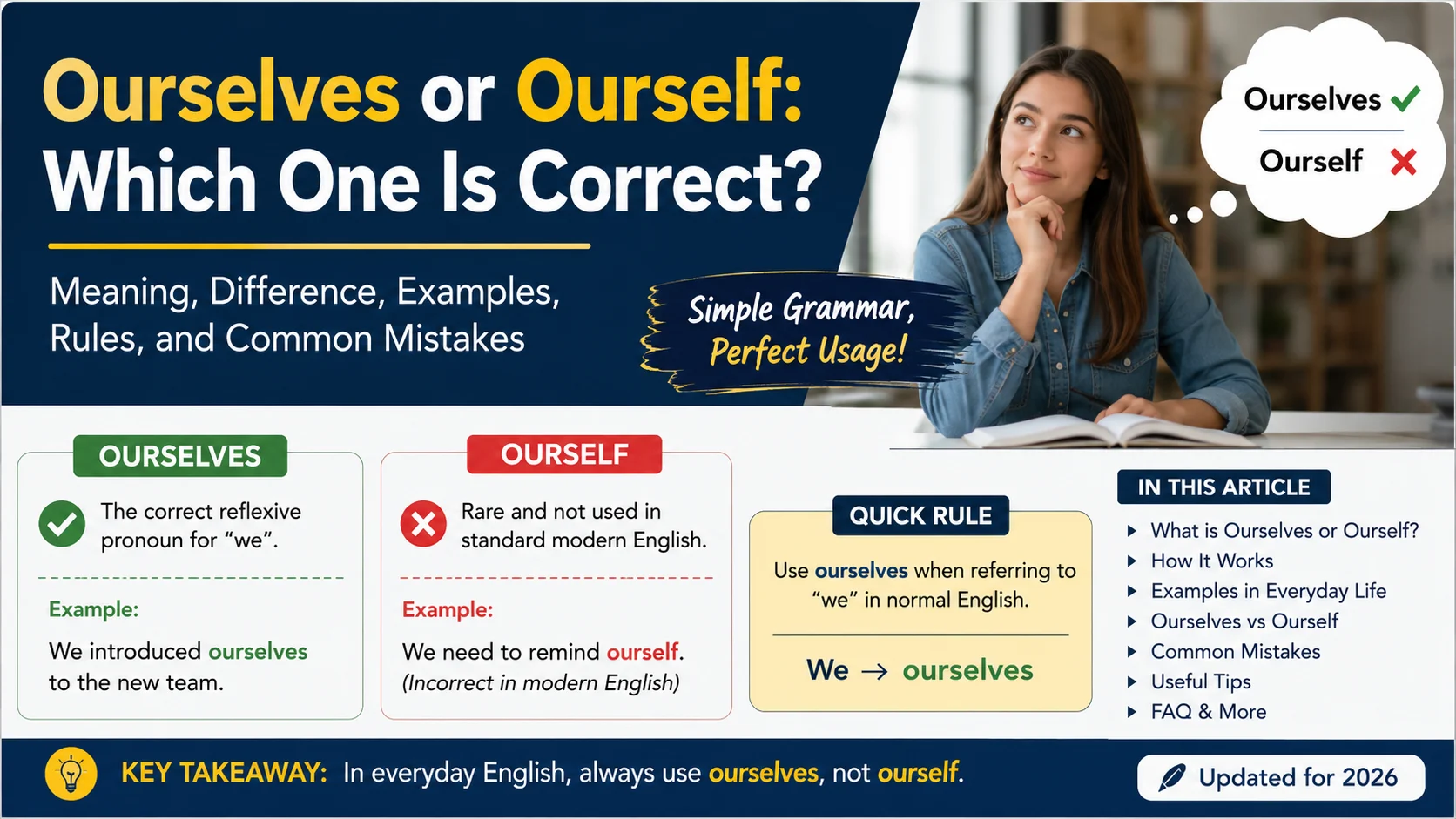
For everyday English, the answer is usually simple: ourselves is the correct reflexive pronoun for we. For example, we say “We introduced ourselves” and “We enjoyed ourselves.” The form ourself is rare and appears mainly in specialized, historical, or dialectal contexts.
In everyday conversations, people often use ourselves to talk about actions that return to the same group of people who performed them. Updated for 2026, this guide explains the difference clearly, with practical examples for students, writers, English learners, and everyday speakers.
What Is “Ourselves or Ourself”?
What Does “Ourselves” Mean?
Ourselves is a reflexive pronoun. It normally refers back to the subject we when the people performing an action are also affected by that action.
For example:
We prepared ourselves for the presentation.
The subject is we, and ourselves refers back to the same people.
Another example is:
We reminded ourselves to stay focused.
The group reminded the same group of people to stay focused.
What Does “Ourself” Mean?
Ourself is a much less common form. It is not normally used as the standard reflexive pronoun for we in modern English.
It can appear in:
- Historical writing
- Certain dialects
- Highly formal or specialized contexts
- Situations where we refers to one person speaking institutionally or authoritatively
For ordinary modern English, however, ourselves is the correct choice.
The Quick Answer
If you are asking:
“Should I write ourselves or ourself?”
Use:
Ourselves
when referring to we in normal modern English.
How “Ourselves” Works in English
Ourselves as a Reflexive Pronoun
A reflexive pronoun refers back to the subject of the sentence.
For example:
We taught ourselves Spanish.
“We” performs the action, and “ourselves” refers back to “we.”
Other English reflexive pronouns follow a similar pattern:
- I → myself
- You → yourself
- He → himself
- She → herself
- It → itself
- We → ourselves
- You → yourselves
- They → themselves
This makes ourselves the standard reflexive form associated with we.
Ourselves for Emphasis
Ourselves can also emphasize who performed an action.
For example:
We built the website ourselves.
This emphasizes that the group personally built the website.
You can also place it directly after the subject:
We ourselves chose the design.
Here, ourselves adds emphasis to we.
Ourselves or Ourself: The Main Difference
The biggest difference is standard usage.
| Word | Standard Modern English | Typical Use | Example |
|---|---|---|---|
| ourselves | Yes | Reflexive/emphatic pronoun for “we” | We helped ourselves. |
| ourself | Rare | Historical, dialectal, or specialized contexts | Rare in everyday English |
For students and most writers, the practical rule is:
We → ourselves
You normally should not replace ourselves with ourself.
Examples of “Ourselves” in Everyday Life
Getting Ready
We prepared ourselves for the interview.
The group made itself ready for the interview.
Introducing a Group
We introduced ourselves to the new students.
Each person introduced themselves as part of the group.
Having Fun
We enjoyed ourselves at the festival.
The group had a good time.
Learning Independently
We taught ourselves how to edit videos.
The group learned the skill independently.
Taking Responsibility
We blamed ourselves for the mistake.
The group accepted responsibility for what happened.
40 Examples of Ourselves or Ourself
The following examples show the natural use of ourselves. They also demonstrate why ourself is generally not the form you want in ordinary modern English.
1. We Introduced Ourselves
Example: We introduced ourselves to the teacher.
The members of the group explained who they were.
2. We Enjoyed Ourselves
Example: We enjoyed ourselves at the concert.
This means the group had a pleasant and enjoyable experience.
3. We Prepared Ourselves
Example: We prepared ourselves for the exam.
The group got ready for the examination.
4. We Reminded Ourselves
Example: We reminded ourselves to stay calm.
The group gave itself an important reminder.
5. We Taught Ourselves
Example: We taught ourselves how to use the software.
The group learned the skill without relying completely on an instructor.
6. We Challenged Ourselves
Example: We challenged ourselves to finish the project early.
The group created a difficult but achievable goal.
7. We Organized Ourselves
Example: We organized ourselves into smaller teams.
The group arranged its members into separate teams.
8. We Congratulated Ourselves
Example: We congratulated ourselves after completing the project.
The group recognized its own success.
9. We Expressed Ourselves
Example: We expressed ourselves through art.
The group used art to communicate feelings or ideas.
10. We Protected Ourselves
Example: We protected ourselves from the rain.
The group took action to stay dry and safe.
11. We Helped Ourselves
Example: We helped ourselves to some snacks.
The group took snacks for its members, usually with permission.
12. We Asked Ourselves
Example: We asked ourselves whether the decision was correct.
The group considered the question carefully.
13. We Forgave Ourselves
Example: We forgave ourselves for making a small mistake.
The group stopped blaming itself for an error.
14. We Blamed Ourselves
Example: We blamed ourselves for missing the deadline.
The group accepted responsibility for the missed deadline.
15. We Controlled Ourselves
Example: We controlled ourselves during the argument.
The group managed its emotions and behavior.
16. We Looked After Ourselves
Example: We need to look after ourselves during busy weeks.
The group needs to take care of its own needs.
17. We Found Ourselves in a New Situation
Example: We found ourselves in a completely new situation.
The group unexpectedly ended up in that circumstance.
18. We Made Ourselves Comfortable
Example: We made ourselves comfortable before the movie began.
The group arranged things so everyone could relax.
19. We Kept Ourselves Busy
Example: We kept ourselves busy during the weekend.
The group found activities to stay occupied.
20. We Trusted Ourselves
Example: We trusted ourselves to make the right decision.
The group had confidence in its own judgment.
21. We Motivated Ourselves
Example: We motivated ourselves to keep studying.
The group encouraged itself to continue working.
22. We Tested Ourselves
Example: We tested ourselves with a vocabulary quiz.
The group used the quiz to measure its knowledge.
23. We Pushed Ourselves
Example: We pushed ourselves to finish the assignment.
The group made an extra effort to complete the work.
24. We Gave Ourselves More Time
Example: We gave ourselves another week to finish the project.
The group allowed itself additional time.
25. We Corrected Ourselves
Example: We corrected ourselves after noticing the error.
The group recognized and fixed its own mistake.
26. We Defended Ourselves
Example: We defended ourselves against the unfair criticism.
The group responded to criticism and protected its position.
27. We Promised Ourselves
Example: We promised ourselves that we would try again.
The group made a commitment to itself.
28. We Told Ourselves the Truth
Example: We finally told ourselves the truth.
The group honestly accepted the reality of the situation.
29. We Gave Ourselves a Break
Example: We decided to give ourselves a short break.
The group allowed itself some time to rest.
30. We Made Ourselves Clear
Example: We made ourselves clear during the meeting.
The group communicated its ideas in an understandable way.
31. We Expressed Ourselves Creatively
Example: We expressed ourselves creatively through photography.
Photography gave the group a way to communicate ideas and feelings.
32. We Found Ourselves Laughing
Example: We found ourselves laughing at the unexpected joke.
The group began laughing almost naturally or unexpectedly.
33. We Prepared Ourselves Mentally
Example: We prepared ourselves mentally for the competition.
The group became psychologically ready for the challenge.
34. We Reminded Ourselves of the Goal
Example: We reminded ourselves of the main goal.
The group focused again on what it wanted to accomplish.
35. We Challenged Ourselves With New Ideas
Example: We challenged ourselves with new writing techniques.
The group deliberately tried unfamiliar approaches.
36. We Kept Ourselves Motivated
Example: We kept ourselves motivated throughout the project.
The group maintained its energy and determination.
37. We Took Care of Ourselves
Example: We took care of ourselves during the busy season.
The group made time for its own needs and well-being.
38. We Were Proud of Ourselves
Example: We were proud of ourselves after reaching our goal.
The group felt satisfaction about its achievement.
39. We Learned to Trust Ourselves
Example: We learned to trust ourselves when making difficult decisions.
The group developed confidence in its own judgment.
40. We Told Ourselves to Keep Going
Example: We told ourselves to keep going when the work became difficult.
The group encouraged itself not to give up.
Is “Ourself” Ever Correct?
Historical Usage
You may find ourself in older texts. English has changed over time, and historical writers sometimes used forms that are unusual today.
Therefore, encountering ourself in an old document does not automatically mean that the writer made an error.
Institutional “We”
There are contexts in which a single speaker uses we to represent an organization, institution, monarch, or other authority. In rare formal or historical usage, ourself may appear with this special use of we.
However, this is not the normal grammar used in everyday modern English.
Dialectal English
Some regional varieties may use ourself differently from standard written English.
If your goal is to write standard English for school, business, websites, or general readers, ourselves is the safer and expected choice.
Ourselves vs Related Pronouns
Understanding related pronouns can make the rule easier.
Ourselves vs Us
Us is an object pronoun.
The teacher helped us.
Ourselves is reflexive.
We helped ourselves.
The second sentence means that the group helped its own members.
Ourselves vs Our
Our expresses possession.
Our project is ready.
Ourselves refers back to we.
We completed the project ourselves.
Ourselves vs Themselves
Use ourselves with we.
We prepared ourselves.
Use themselves with they.
They prepared themselves.
Ourselves vs Yourselves
Use ourselves when the subject is we.
We introduced ourselves.
Use yourselves when speaking directly to more than one person.
You should introduce yourselves.
How to Use “Ourselves” Correctly
1. Find the Subject
Look for we.
We prepared ourselves.
2. Check Whether the Action Comes Back to the Subject
If the group is performing an action on the same group, ourselves is appropriate.
We congratulated ourselves.
3. Use Ourselves for Emphasis
You can use it to stress personal involvement.
We ourselves designed the website.
4. Avoid Ourself in Ordinary Modern Writing
Unless you have a specific historical, dialectal, or specialized reason, use ourselves.
5. Match the Pronoun With the Subject
The subject and reflexive pronoun should agree.
- We → ourselves
- They → themselves
- I → myself
- He → himself
- She → herself
Common Mistakes People Make With Ourselves or Ourself
Mistake 1: “We Taught Ourself”
Incorrect in standard modern English:
We taught ourself English.
Correct:
We taught ourselves English.
Mistake 2: Treating “Ourself” as the Normal Singular Form
English does not normally use ourself as a simple singular equivalent of ourselves.
If one person is speaking, the ordinary reflexive pronoun is myself:
I taught myself English.
If several people are speaking:
We taught ourselves English.
Mistake 3: Using “Ourselves” With “They”
Incorrect:
They prepared ourselves.
Correct:
They prepared themselves.
Mistake 4: Confusing “Us” and “Ourselves”
Incorrect:
We bought us some new books when the intended meaning is reflexive.
Depending on context, the natural sentence may be:
We bought ourselves some new books.
Mistake 5: Using Ourselves Without a Clear Reference
The reader should be able to understand who ourselves refers to.
We asked ourselves a difficult question.
The reference is clear because ourselves refers to we.
Ourselves in Essays, Poems, and Social Media
In Academic Essays
We should remind ourselves that evidence is essential when evaluating an argument.
This creates a clear, inclusive academic tone.
In Creative Writing
We found ourselves walking through a quiet city after midnight.
This can create a sense of discovery or unexpected circumstances.
In Poetry
We carry pieces of ourselves wherever we go.
The reflexive pronoun can support themes of identity and personal experience.
In Social Media Captions
Proud of ourselves for reaching this milestone!
This is natural for celebrating a group achievement.
In Daily Conversation
We should give ourselves a break.
This is a common and natural conversational expression.
From real-life writing experience, ourselves is especially useful when you want to express shared responsibility, group identity, personal effort, or collective achievement.
Famous or Popular Expressions With “Ourselves”
Several familiar English expressions use ourselves naturally.
“Be Ourselves”
We should just be ourselves.
This means behaving naturally rather than pretending to be someone else.
“Believe in Ourselves”
We need to believe in ourselves.
This means having confidence in our own abilities.
“Be Proud of Ourselves”
We should be proud of ourselves.
This expresses satisfaction with a group’s achievement.
“Take Care of Ourselves”
We need to take care of ourselves.
This means looking after our own needs.
“Learn From Ourselves”
We can learn from ourselves as well as from others.
This emphasizes reflection and personal experience.
Why Learning This Difference Matters
The difference between ourselves or ourself may seem small, but using the standard form makes your English sound more natural and polished.
Students may encounter this grammar point in:
- English exams
- Grammar exercises
- School essays
- Reading comprehension
- Creative writing
- Professional communication
- Social media
- Everyday conversations
For writers, choosing ourselves correctly also helps create smooth, professional sentences.
Instead of:
We need to remind ourself of the goal.
write:
We need to remind ourselves of the goal.
The second version is the standard form expected by modern English readers.
Internal Links to Related English Topics
If this article is part of an English-learning website, consider linking it to related topics such as:
- Reflexive Pronouns: Complete Guide
- Myself vs Me: What’s the Difference?
- Yourself vs Yourselves
- We vs Us: Correct Usage
- Themselves vs Theirself
- Common English Grammar Mistakes
- Subject and Object Pronouns
- Types of Pronouns in English
- Commonly Confused English Words
These internal links can help readers explore related grammar lessons and improve their overall understanding of English pronouns.
Frequently Asked Questions
Which is correct: ourselves or ourself?
For normal modern English, ourselves is correct when referring to we.
Example:
We prepared ourselves for the meeting.
Is “ourself” a real word?
Yes, ourself does occur in English, but it is rare. It can appear in historical, dialectal, or specialized contexts. It is not the normal reflexive pronoun for we in standard modern English.
Can I say “we did it ourself”?
In standard modern English, use:
We did it ourselves.
What is the reflexive pronoun for “we”?
The standard reflexive pronoun for we is ourselves.
We taught ourselves how to cook.
What is the difference between ourselves and themselves?
Ourselves refers back to we, while themselves refers back to they.
We prepared ourselves.
They prepared themselves.
Quick Grammar Cheat Sheet
Remember this pattern:
- I → myself
- You → yourself
- He → himself
- She → herself
- It → itself
- We → ourselves
- You → yourselves
- They → themselves
Correct Modern Examples
- We introduced ourselves.
- We enjoyed ourselves.
- We prepared ourselves.
- We taught ourselves.
- We challenged ourselves.
- We reminded ourselves.
- We congratulated ourselves.
- We expressed ourselves.
The Easy Rule
If the subject is “we” and you need a reflexive pronoun, use “ourselves.”
Conclusion
When choosing between ourselves or ourself, the answer for ordinary modern English is clear: use ourselves. It is the standard reflexive pronoun that refers back to we, as in “We prepared ourselves” or “We enjoyed ourselves.”
Ourself is a rare form that may appear in historical, dialectal, or specialized contexts, but it is not the normal choice for everyday standard English.
Updated for 2026, the easiest rule to remember is we → ourselves. Practice using ourselves in essays, conversations, captions, stories, and everyday sentences, and the correct form will quickly become natural.
DISCOVER MORE ARTICLES
Ourself vs Ourselves: Meaning, Difference, and Usage 2026
Setup vs Set Up: Common Mistakes and Examples 2026
Swap vs Swop: Simple Meaning and Usage Explained 2026
