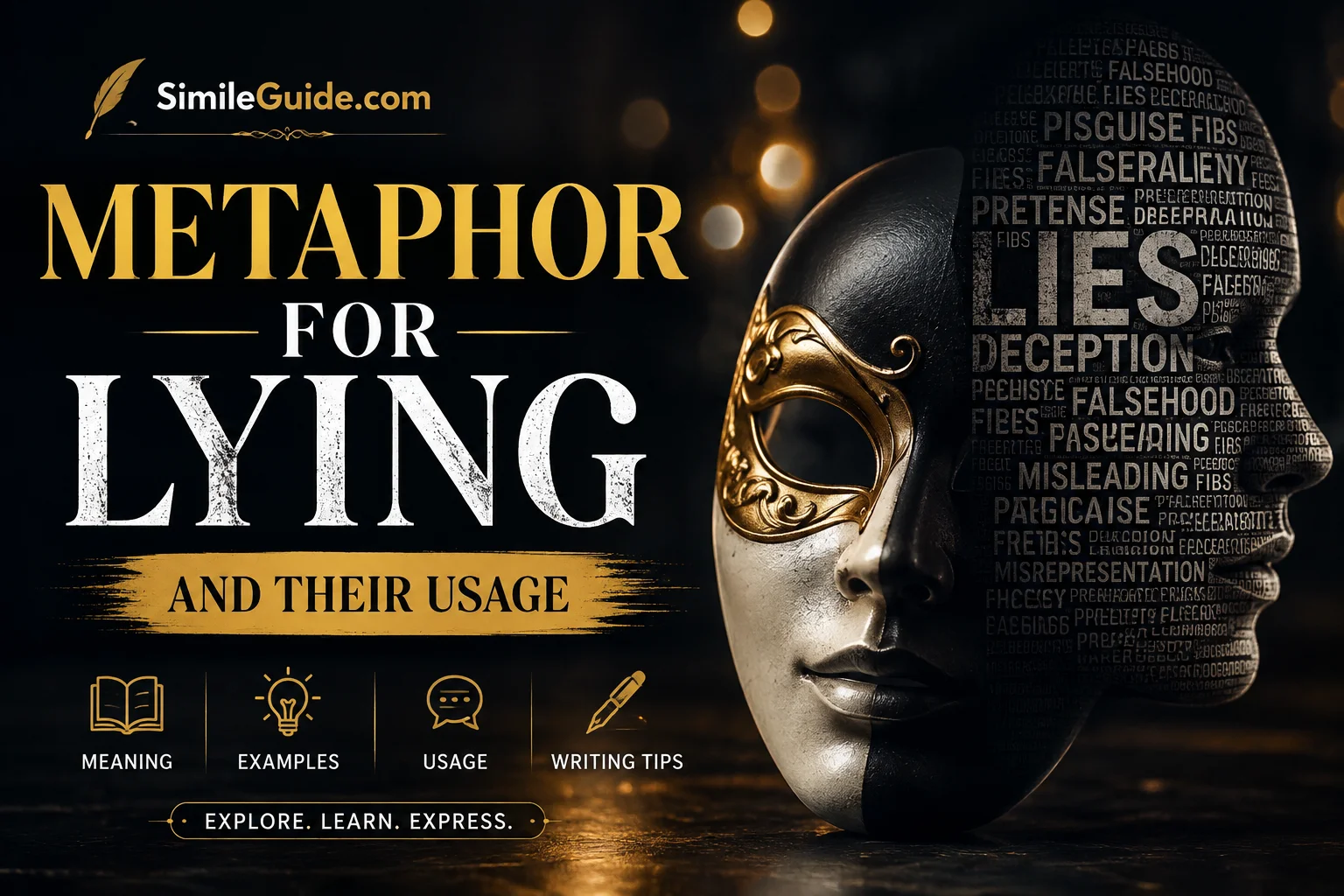
Lying can be described in many ways, but a metaphor for lying makes the idea more vivid by comparing dishonesty to something familiar, such as a mask, a web, a shadow, or a broken mirror.
For example, saying “His lie was a tangled web” does not mean an actual web exists. It suggests that one lie can lead to more lies until the person becomes trapped in a complicated story.
Whether you are a student learning figurative language, a writer looking for stronger descriptions, or simply searching for a quick way to describe dishonesty, metaphors can make your words more expressive.
Updated for 2026, this guide explains what a metaphor for lying means, how it works, where to use it, and provides 40 creative examples with simple meanings.
What Is a Metaphor for Lying?
Simple Definition
A metaphor for lying is a figurative expression that compares lying or dishonesty to another object, action, situation, or idea without using “like” or “as.”
For example:
His lie was a tangled web.
This does not mean that the person literally created a web. The metaphor suggests that the lie became complicated and difficult to escape.
Another example is:
She hid behind a mask of lies.
The “mask” represents the false story or dishonest behavior being used to hide the truth.
Why Use Metaphors for Lying?
Lying is an abstract behavior. A metaphor gives that behavior a visual form that readers can easily understand.
A lie can be presented as:
- A web because it becomes complicated
- A mask because it hides the truth
- A shadow because it follows someone
- A poison because it can cause harm
- A crack in a mirror because it damages trust
- A house of cards because it can collapse easily
- A maze because it can become difficult to navigate
In everyday conversations, people often use metaphors for lying to explain how dishonesty affects relationships, trust, and communication.
How a Metaphor for Lying Works
Turning an Abstract Idea Into an Image
Lying is not something you can physically hold. A metaphor allows readers to imagine its effects.
Compare these two sentences:
He kept lying.
This is clear but plain.
His lies became a maze with no exit.
The second sentence creates a stronger image. The reader can imagine someone becoming trapped in increasingly complicated falsehoods.
The Basic Structure
You can create a metaphor by identifying a quality of lying and connecting it with something that has the same quality.
For example:
Lying = hiding
Possible metaphor:
A lie is a curtain hiding the truth.
Or:
Lying = becoming complicated
Possible metaphor:
His story became a tangled web.
Or:
Lying = damaging trust
Possible metaphor:
Every lie was another crack in the mirror of trust.
The key is to create a comparison that feels natural and meaningful.
40 Metaphors for Lying With Meanings and Examples
Below are 40 original and useful metaphors for lying. Each example includes a simple explanation so students and writers can understand exactly what the metaphor communicates.
1. A Tangled Web
Metaphor: His lie was a tangled web.
Meaning: A lie can become increasingly complicated as more false details are added.
Example: One small lie became a tangled web that he could no longer control.
2. A Mask
Meaning: A mask conceals someone’s real appearance, just as a lie can conceal reality.
Metaphor: Her lie was a mask hiding the truth.
Example: His confident story was only a mask covering his mistake.
3. A Shadow
Metaphor: The lie was a shadow following him.
Meaning: A lie may continue to affect someone even after it has been told.
Example: The lie became a shadow that followed him wherever he went.
4. A House of Cards
Metaphor: His story was a house of cards.
Meaning: The lie depended on fragile details and could collapse when one part was questioned.
Example: His explanation was a house of cards that fell apart after one simple question.
5. A Maze
Metaphor: Her lies were a maze.
Meaning: A complicated series of lies can make it difficult to find the truth.
Example: His excuses created a maze that confused everyone.
6. Poison
Metaphor: The lie was poison.
Meaning: Dishonesty can gradually damage relationships and trust.
Example: The lie was poison slowly weakening their friendship.
7. A Crack in Glass
Metaphor: The lie was a crack in the glass of trust.
Meaning: One lie can damage trust even if the relationship continues.
Example: That lie was the first crack in their once-perfect friendship.
8. A Broken Mirror
Metaphor: His lie was a broken mirror.
Meaning: A lie can distort how people see each other and damage their understanding of reality.
Example: The deception became a broken mirror reflecting a distorted version of their relationship.
9. Smoke
Metaphor: Her explanation was smoke hiding the truth.
Meaning: The person is using confusing words to prevent others from seeing what really happened.
Example: His complicated answer was smoke designed to hide the truth.
10. A Curtain
Metaphor: The lie was a curtain over the truth.
Meaning: The lie conceals reality.
Example: Her excuse became a curtain hiding what had really happened.
11. A House Built on Sand
Metaphor: His story was a house built on sand.
Meaning: The lie had no strong foundation and could easily collapse.
Example: His entire explanation was a house built on sand.
12. A False Map
Metaphor: The lie was a false map.
Meaning: A lie can lead someone in the wrong direction.
Example: His false promises became a map leading her farther away from the truth.
13. A Locked Door
Metaphor: The lie was a locked door between them.
Meaning: Dishonesty can prevent people from communicating openly.
Example: His deception became a locked door between the two friends.
14. A Fog
Metaphor: The lie was fog around the truth.
Meaning: A lie can make a situation unclear or confusing.
Example: Her excuses created a fog that made the real story difficult to see.
15. A False Trail
Metaphor: His lie was a false trail.
Meaning: The lie deliberately directs someone away from the truth.
Example: The invented story was a false trail leading investigators in the wrong direction.
16. A Leaking Boat
Metaphor: His story was a leaking boat.
Meaning: The lie contained problems that eventually became impossible to ignore.
Example: His explanation was a leaking boat, and every new question brought another problem.
17. A Domino
Metaphor: The first lie was a falling domino.
Meaning: One lie can trigger a series of additional lies or consequences.
Example: That first false statement was a falling domino that started a chain of excuses.
18. A Trap
Metaphor: The lie was a trap of his own making.
Meaning: Someone can become trapped by the false story they created.
Example: His lie became a trap when people started asking for details.
19. A Wall
Metaphor: Her lies built a wall between them.
Meaning: Dishonesty can create emotional distance.
Example: Every false excuse added another brick to the wall between the friends.
20. A Wound
Metaphor: The lie was a wound in their friendship.
Meaning: Lying can emotionally hurt people and damage relationships.
Example: The deception became a wound that took years to heal.
21. A False Foundation
Metaphor: Their relationship was standing on a foundation of lies.
Meaning: The relationship depended on dishonesty rather than truth.
Example: Their friendship could not remain strong because it stood on a foundation of lies.
22. A Broken Compass
Metaphor: The lie was a broken compass.
Meaning: A lie can lead someone away from the correct path.
Example: His dishonest advice was a broken compass pointing her in the wrong direction.
23. A Thread
Metaphor: His lie was a thread that kept unraveling.
Meaning: As people discover inconsistencies, the false story begins to fall apart.
Example: One question pulled the thread, and the entire story began to unravel.
24. A Costume
Metaphor: The lie was a costume hiding his real intentions.
Meaning: The lie disguises what someone truly thinks or wants.
Example: His friendly words were a costume covering his selfish motives.
25. A Puppet Show
Metaphor: Her lies were a puppet show.
Meaning: The person is manipulating what others see or believe.
Example: His carefully planned excuses were a puppet show designed to control the conversation.
26. A Fake Door
Metaphor: The promise was a fake door.
Meaning: The promise appears to offer a solution but does not actually lead anywhere.
Example: His promise of an easy solution was a fake door hiding the real problem.
27. A Rusted Chain
Metaphor: His lies were a rusted chain.
Meaning: Repeated dishonesty can hold someone back and become increasingly difficult to break.
Example: Years of deception became a rusted chain around their relationship.
28. A Thorn
Metaphor: The lie was a thorn in their friendship.
Meaning: The lie caused ongoing discomfort or resentment.
Example: That old deception remained a thorn in their friendship.
29. A Crumbling Bridge
Metaphor: The lie was a missing plank in the bridge of trust.
Meaning: Dishonesty makes it harder for people to maintain a secure relationship.
Example: Each lie removed another plank from the bridge connecting them.
30. A False Picture
Metaphor: The lie painted a false picture.
Meaning: A lie creates an inaccurate impression of reality.
Example: His story painted a false picture of what happened that evening.
31. A Broken Clock
Metaphor: Her excuse was a broken clock.
Meaning: The story may appear convincing at first but does not work when examined carefully.
Example: Her explanation was a broken clock that made sense only for a moment.
32. A Paper Shield
Metaphor: His lie was a paper shield.
Meaning: The lie was intended to protect him but was too weak to last.
Example: The excuse was only a paper shield against the consequences.
33. A Crumbling Castle
Metaphor: His story was a crumbling castle.
Meaning: The lie may look impressive but has an unstable foundation.
Example: His detailed explanation was a crumbling castle built on false information.
34. A Dark Cloud
Metaphor: The lie was a dark cloud over their friendship.
Meaning: The dishonesty created an atmosphere of suspicion and sadness.
Example: The secret became a dark cloud that remained over their relationship.
35. A False Light
Metaphor: The lie was a false light.
Meaning: It appeared to provide guidance but actually led people away from the truth.
Example: His advice was a false light that sent everyone in the wrong direction.
36. A Locked Chest
Metaphor: The lie was a locked chest hiding the truth.
Meaning: The metaphor emphasizes secrecy and concealment.
Example: Her story was a locked chest filled with secrets.
37. A Balloon
Metaphor: His lie was a balloon growing larger with every excuse.
Meaning: A lie can become bigger and more difficult to maintain as more details are added.
Example: His original excuse became a balloon inflated by countless new explanations.
38. A Snowball
Metaphor: The lie was a snowball rolling downhill.
Meaning: One lie can grow rapidly into a much larger problem.
Example: The small falsehood became a snowball of deception.
39. A Broken Promise
Metaphor: The lie was a broken promise between them.
Meaning: The metaphor emphasizes the damage dishonesty can cause to expectations and trust.
Example: Her lie felt like a broken promise that changed their relationship.
40. A Knot
Metaphor: The lie was a knot in the truth.
Meaning: Dishonesty can make an otherwise simple situation complicated.
Example: His false story tied a knot in what should have been a simple explanation.
Metaphor for Lying vs. Related Figurative Language
A metaphor for lying is only one way to describe dishonesty.
Metaphor
His lie was a tangled web.
It directly compares the lie with a web.
Simile
His lie was like a tangled web.
The comparison uses “like.”
Personification
The lie followed him everywhere.
The lie is given an action associated with something living.
Hyperbole
She told a thousand lies before breakfast.
This deliberately exaggerates the number for emphasis.
Idiom
He was pulling my leg.
An idiom has a meaning that cannot always be understood literally from its individual words.
How to Create Your Own Metaphor for Lying
Creating original metaphors is easier when you focus on the effect of the lie.
1. Decide What the Lie Does
Does it:
- Hide the truth?
- Hurt someone?
- Create confusion?
- Damage trust?
- Grow over time?
- Lead someone in the wrong direction?
- Protect someone temporarily?
2. Find an Object With the Same Quality
For example:
Hides → mask, curtain, fog
Confuses → maze, puzzle, fog
Damages → poison, crack, wound
Grows → snowball, balloon, wildfire
Misleads → false map, broken compass, false trail
3. Combine the Ideas
You could write:
His lie was a fog around the truth.
Or:
Her excuses were bricks in a wall of deception.
4. Keep It Clear
A creative metaphor should still be understandable.
Instead of combining five unrelated images, choose one strong comparison that communicates your intended meaning.
Common Mistakes With Metaphors for Lying
Using “Like” and Calling It a Metaphor
His lie was like a web.
This is technically a simile, not a direct metaphor.
A metaphor would be:
His lie was a web.
Making the Comparison Too Complicated
A metaphor should help the reader understand an idea rather than make it harder.
Keep the comparison focused.
Mixing Too Many Metaphors
Avoid writing something such as:
His lie was a web, a storm, a broken mirror, and a sinking ship.
Using too many images at once can weaken the writing.
Using Metaphors Without Context
A metaphor becomes more powerful when the surrounding sentence explains why the comparison works.
Practical Uses for a Metaphor for Lying
For Students
Students can use metaphors in:
- English essays
- Creative writing
- Literary analysis
- Descriptive paragraphs
- School presentations
- Poetry assignments
For example:
The character’s lies became a maze that eventually trapped him.
This could be useful when analyzing a character whose dishonesty creates problems.
For Writers
Writers can use metaphors to:
- Develop characters
- Create emotional depth
- Build atmosphere
- Show consequences
- Avoid repetitive descriptions
For Social Media
Short metaphors can create thoughtful captions:
- A lie is a crack in trust.
- Truth needs no disguise.
- Some lies become walls.
- A small lie can become a snowball.
- Trust is fragile; lies leave marks.
Internal Link Ideas
For a website focused on English, figurative language, and writing, this article could naturally link to related topics such as:
- What Is a Metaphor?
- Metaphor vs. Simile
- Examples of Personification
- Examples of Hyperbole
- Metaphors for Truth
- Metaphors for Trust
- Metaphors for Secrets
- Metaphors for Fear
- Metaphors for Love
- Figurative Language Examples
These links can help readers understand related literary devices and explore similar topics.
Frequently Asked Questions
What is a good metaphor for lying?
A strong example is “A lie is a tangled web.” It suggests that one false statement can lead to more complicated lies and eventually become difficult to escape.
What is a metaphor for someone who lies?
You might describe a dishonest person as “a mask hiding the truth” or say “he is a weaver of tangled stories.” These expressions emphasize deception and concealment.
Is “lying is like a web” a metaphor?
No. “Lying is like a web” is a simile because it uses the word “like.” A metaphor would be “Lying is a web.”
What metaphor represents the consequences of lying?
“A lie is a snowball rolling downhill” is useful because it suggests that a small lie can grow into a much larger problem.
Can metaphors for lying be used in essays?
Yes. They can make essays and creative writing more vivid. Use them where they support your main idea, particularly when describing characters, emotions, conflict, or consequences.
Conclusion
A metaphor for lying turns an abstract idea—dishonesty—into something readers can see and feel. A lie can become a web, mask, shadow, maze, poison, broken mirror, false map, or snowball, depending on the meaning you want to communicate.
The most effective metaphor depends on context. If you want to emphasize confusion, use a maze. If you want to show concealment, use a mask. If you want to describe growing consequences, a snowball works well.
Practice creating your own comparisons by thinking about what lying does and then finding an object with a similar quality. With a little creativity, even a simple sentence about dishonesty can become much more powerful and memorable.
DISCOVER MORE ARTICLES
Metaphors for Stars: 40 Creative Examples and Meanings 2026
Metaphor for Night: 50 Creative Examples and Meanings 2026
AFK Meaning: What Does AFK Mean in Texting and Gaming? 2026
