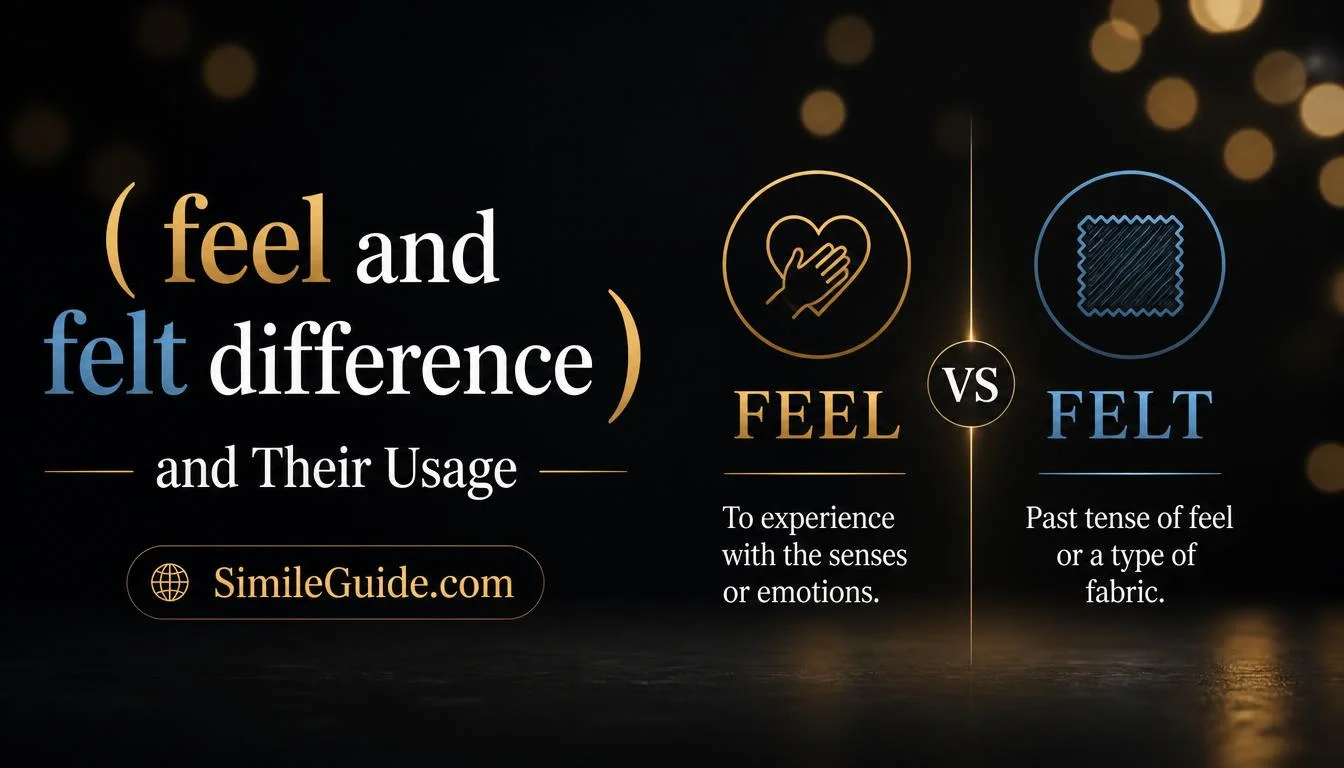
Have you ever wondered whether to say “I feel happy” or “I felt happy”? Both sentences are correct, but they describe feelings at different times. Understanding the feel and felt difference can make your English clearer, especially when speaking about emotions, experiences, opinions, and physical sensations.
The simple rule is this: feel is generally used for the present, while felt is the past form of feel. However, their use becomes more interesting when they appear with helping verbs such as have, had, will, and can.
In everyday conversations, people often use feel and felt to describe emotions, opinions, physical sensations, and personal experiences. From real-life writing experience, choosing the correct form depends mainly on when the feeling happened.
This guide explains the feel and felt difference in plain English, with practical examples for students, writers, social media users, and everyday conversations.
Updated for 2026: This guide uses modern examples and common English situations to make the difference easy to understand.
What Is the Feel and Felt Difference?
The main difference between feel and felt is time.
Meaning of Feel
Feel is the base form of the verb. It is commonly used to talk about something happening now, something that happens regularly, or something that may happen in the future.
Example: “I feel tired today.”
This means the person is experiencing tiredness now.
Example: “I feel excited about the trip.”
The excitement is being experienced in the present.
Meaning of Felt
Felt is the past tense and past participle of feel. It is used when talking about a feeling or experience that happened in the past.
Example: “I felt tired after the journey.”
The tiredness happened after the journey and is being described as a past experience.
Example: “She felt nervous before the interview.”
Her nervousness occurred at a particular time in the past.
Feel vs. Felt at a Glance
| Word | Grammatical Form | Main Use | Example |
|---|---|---|---|
| Feel | Base/present form | Present or general situations | I feel happy. |
| Felt | Past form | Past situations | I felt happy yesterday. |
| Felt | Past participle | Perfect tenses | I have felt better recently. |
| Feel | After modal verbs | Possibility or future-related situations | I might feel better tomorrow. |
The easiest way to remember the difference is:
Feel = present/base form
Felt = past form
How Feel and Felt Are Used
The verb feel has several common uses in English. It can describe emotions, physical sensations, opinions, instincts, and general impressions.
Feel for Present Emotions
Use feel when an emotion is happening now.
Example: “I feel happy today.”
The speaker is happy at the moment.
Example: “I feel nervous about the exam.”
The nervousness exists in the present.
Felt for Past Emotions
Use felt when the emotion happened in the past.
Example: “I felt nervous before the exam.”
The nervousness occurred before the exam in the past.
Example: “He felt proud after winning the competition.”
His feeling of pride happened after the past event.
Feel for Physical Sensations
Feel can describe what your body is experiencing.
Example: “I feel cold.”
The speaker is experiencing coldness now.
Example: “My hands feel warm.”
The speaker is describing the current physical sensation.
Felt for Past Physical Sensations
Example: “I felt cold when I went outside.”
The feeling of cold happened in the past.
Example: “Her hands felt warm after she came inside.”
The warmth was experienced at an earlier time.
Feel for Opinions and Impressions
Feel can also mean believe, think, or have an opinion.
Example: “I feel that this is the right decision.”
Here, feel means the speaker has a present opinion.
Example: “I felt that something was wrong.”
Here, felt describes an opinion or impression that existed in the past.
Feel and Felt Difference in Tenses
Understanding verb tense makes this topic much easier.
Present Simple: Feel
Use feel to talk about current or regular feelings.
Example: “I feel confident when I prepare well.”
This describes a present or repeated experience.
Past Simple: Felt
Use felt for completed experiences in the past.
Example: “I felt confident during yesterday’s presentation.”
The presentation happened in the past.
Present Perfect: Have Felt
Use have felt when a past feeling has a connection to the present.
Example: “I have felt much better this week.”
The improvement began earlier and remains relevant now.
Past Perfect: Had Felt
Use had felt when one past feeling happened before another past event.
Example: “I had felt nervous before the teacher called my name.”
The nervousness came first, followed by the teacher calling the student’s name.
Future: Will Feel
Use will feel when discussing a future feeling.
Example: “You will feel more confident after practicing.”
The confidence is expected to happen later.
Modal Verbs: Can Feel, Might Feel, Should Feel
After modal verbs, use feel, not felt.
Example: “You might feel tired after the workout.”
Example: “You should feel better after some rest.”
Example: “I can feel the difference already.”
40 Feel and Felt Examples With Meanings
The following examples show how feel and felt work in real conversations, writing, captions, essays, and everyday situations.
1. I Feel Happy
Meaning: I am experiencing happiness now.
Example: “I feel happy when I spend time with my family.”
The feeling is current or generally experienced.
2. I Felt Happy
Meaning: I experienced happiness in the past.
Example: “I felt happy when my friends surprised me.”
The happiness happened during a past event.
3. I Feel Tired
Meaning: I am tired now.
Example: “I feel tired after studying for several hours.”
The speaker is describing a current physical condition.
4. I Felt Tired
Meaning: I was tired at an earlier time.
Example: “I felt tired after completing my assignment.”
The tiredness belonged to a past situation.
5. I Feel Nervous
Meaning: I am nervous now.
Example: “I feel nervous before important presentations.”
The speaker is describing a current or recurring emotion.
6. I Felt Nervous
Meaning: I was nervous in the past.
Example: “I felt nervous before giving my first speech.”
The nervousness happened during a past experience.
7. She Feels Excited
Meaning: She is excited now.
Example: “She feels excited about her upcoming vacation.”
Her excitement relates to the present.
8. She Felt Excited
Meaning: She was excited in the past.
Example: “She felt excited when she received the invitation.”
The excitement happened when she received it.
9. They Feel Confident
Meaning: They are confident now.
Example: “They feel confident after practicing every day.”
Their confidence exists in the present.
10. They Felt Confident
Meaning: They were confident at a past time.
Example: “They felt confident during the final presentation.”
The confidence was experienced during a previous event.
11. I Feel Cold
Meaning: I am experiencing coldness now.
Example: “I feel cold, so I am going to wear a jacket.”
The physical sensation is happening now.
12. I Felt Cold
Meaning: I experienced coldness earlier.
Example: “I felt cold when I walked outside last night.”
The cold sensation occurred in the past.
13. He Feels Better
Meaning: He is better now.
Example: “He feels better after getting some rest.”
The improvement is current.
14. He Felt Better
Meaning: He became better at a previous time.
Example: “He felt better after taking a short break.”
The statement refers to a past situation.
15. I Feel Confused
Meaning: I am confused now.
Example: “I feel confused about this grammar rule.”
The confusion exists at the moment.
16. I Felt Confused
Meaning: I was confused earlier.
Example: “I felt confused when I first learned irregular verbs.”
The confusion happened in the past.
17. She Feels Proud
Meaning: She is proud now.
Example: “She feels proud of her hard work.”
Her pride is a current emotion.
18. She Felt Proud
Meaning: She experienced pride in the past.
Example: “She felt proud when she completed the project.”
The pride followed a past achievement.
19. I Feel Relaxed
Meaning: I am relaxed now.
Example: “I feel relaxed after listening to music.”
The speaker describes a current state.
20. I Felt Relaxed
Meaning: I was relaxed at an earlier time.
Example: “I felt relaxed during my weekend vacation.”
The relaxed feeling occurred in the past.
21. We Feel Ready
Meaning: We are ready now.
Example: “We feel ready for the competition.”
The feeling of readiness is current.
22. We Felt Ready
Meaning: We were ready at a past time.
Example: “We felt ready when the competition began.”
The statement describes a past experience.
23. I Feel That You Are Right
Meaning: I currently believe you are right.
Example: “I feel that you are right about this issue.”
Here, feel expresses a present opinion.
24. I Felt That You Were Right
Meaning: I believed you were right at that time.
Example: “I felt that you were right after hearing the explanation.”
The opinion existed in the past.
25. I Can Feel the Wind
Meaning: I can physically sense the wind now.
Example: “I can feel the wind coming through the open window.”
The sensation is happening in the present.
26. I Could Feel the Wind
Meaning: I was able to sense the wind in the past.
Example: “I could feel the wind while I was walking along the beach.”
The physical sensation happened during a past activity.
27. You Will Feel Better
Meaning: You are expected to feel better in the future.
Example: “You will feel better after getting enough sleep.”
The improvement is expected later.
28. You Might Feel Nervous
Meaning: You may experience nervousness.
Example: “You might feel nervous before your first interview.”
The sentence describes a possible future experience.
29. I Have Felt This Way Before
Meaning: I experienced this feeling previously.
Example: “I have felt this way before, so I understand your concern.”
The past experience is connected to the present.
30. I Had Felt Nervous
Meaning: I experienced nervousness before another past event.
Example: “I had felt nervous before the meeting started.”
The nervousness happened first.
31. She Feels Comfortable Here
Meaning: She is comfortable here now.
Example: “She feels comfortable speaking with her classmates.”
The feeling exists in the present.
32. She Felt Comfortable There
Meaning: She was comfortable at that past place or time.
Example: “She felt comfortable at her old school.”
The statement refers to a past experience.
33. This Fabric Feels Soft
Meaning: The fabric has a soft texture when touched.
Example: “This blanket feels soft and warm.”
Here, feel describes a physical quality.
34. The Fabric Felt Soft
Meaning: The fabric seemed soft when touched in the past.
Example: “The blanket felt soft when I touched it yesterday.”
The description refers to a previous experience.
35. I Feel Lucky
Meaning: I believe I am fortunate now.
Example: “I feel lucky to have such supportive friends.”
The speaker expresses a current emotional opinion.
36. I Felt Lucky
Meaning: I believed I was fortunate at a past time.
Example: “I felt lucky when I found my lost phone.”
The feeling occurred after a past event.
37. He Feels Lonely
Meaning: He is experiencing loneliness now.
Example: “He feels lonely when he stays home all weekend.”
The sentence describes his present or recurring experience.
38. He Felt Lonely
Meaning: He experienced loneliness in the past.
Example: “He felt lonely after moving to a new city.”
The loneliness occurred after a past change.
39. I Feel Excited About the Future
Meaning: I am excited now about something that will happen later.
Example: “I feel excited about starting my new course.”
The feeling is present, even though the event is future.
40. I Felt Excited About the Future
Meaning: I experienced excitement about the future in the past.
Example: “I felt excited about the future when I graduated from college.”
The excitement belonged to a past moment.
Feel and Felt vs Related Concepts
Understanding feel and felt difference becomes easier when you compare these words with similar forms.
Feel vs Felt
| Feel | Felt |
|---|---|
| Base/present form | Past form |
| Usually refers to now or general situations | Usually refers to the past |
| I feel happy. | I felt happy. |
| I feel tired. | I felt tired. |
Feel vs Feeling
Feel is a verb, while feeling is the present participle or gerund form.
Example: “I feel nervous.”
Here, feel is the main verb.
Example: “I am feeling nervous.”
Here, feeling appears with am in the present continuous tense.
Feel vs Felt vs Have Felt
These forms can describe different time relationships.
Feel: “I feel better now.”
The feeling is current.
Felt: “I felt better yesterday.”
The feeling happened in the past.
Have felt: “I have felt better this week.”
The past experience has a connection with the present.
How to Use Feel and Felt Correctly
Follow these simple steps when deciding between feel and felt.
1. Identify the Time
Ask yourself: Is the feeling happening now or did it happen before?
If it is happening now, use feel.
Example: “I feel nervous.”
If it happened before, use felt.
Example: “I felt nervous yesterday.”
2. Look for Time Words
Certain words often signal the past.
Common past-time expressions include:
- Yesterday
- Last night
- Last week
- Earlier
- Before
- When I was young
- A few days ago
- During the meeting
Example: “I felt sick yesterday.”
The word yesterday clearly indicates the past.
3. Check for Helping Verbs
After modal verbs such as can, could, may, might, should, and will, use the base form feel.
Correct: “I might feel better tomorrow.”
Incorrect: “I might felt better tomorrow.”
After have or had, use felt.
Correct: “I have felt tired recently.”
Correct: “I had felt nervous before the interview.”
Common Mistakes With Feel and Felt
Mistake 1: Using Felt for the Present
Incorrect:
“I felt happy now.”
Better:
“I feel happy now.”
Because now indicates the present, feel is appropriate.
Mistake 2: Using Feel for a Finished Past Event
Incorrect:
“I feel nervous yesterday.”
Correct:
“I felt nervous yesterday.”
The word yesterday requires the past form.
Mistake 3: Using Felt After a Modal Verb
Incorrect:
“I might felt tired.”
Correct:
“I might feel tired.”
Modal verbs are followed by the base form of the verb.
Mistake 4: Confusing Have Feel With Have Felt
Incorrect:
“I have feel this before.”
Correct:
“I have felt this before.”
The present perfect uses have + past participle, and the past participle of feel is felt.
Mistake 5: Forgetting the Subject
Incorrect:
“She feel happy.”
Correct:
“She feels happy.”
Remember that in the present simple, feel becomes feels with he, she, and it.
Feel and Felt in Everyday Conversations
In everyday conversations, people frequently use these words to describe emotional and physical experiences.
Here are some natural examples:
- “I feel great today.”
- “How do you feel about the idea?”
- “I felt nervous at first.”
- “She feels much better now.”
- “He felt embarrassed after the mistake.”
- “Do you feel ready?”
- “I felt comfortable talking to her.”
- “I feel like going outside.”
- “I felt like giving up.”
- “You will feel proud of yourself.”
Notice that the correct form depends on time and sentence structure, not simply on whether the sentence describes an emotion.
Feel and Felt in Essays and Academic Writing
Students often need these words when writing personal experiences, reflections, narratives, and opinion essays.
Present Writing
Use feel when discussing your current opinion.
Example: “I feel that students learn better when lessons are interactive.”
This expresses a current belief.
Past Narrative
Use felt when describing a previous experience.
Example: “I felt nervous when I entered the classroom for the first time.”
This describes an event that happened in the past.
Reflective Writing
Both forms may appear in the same paragraph.
Example: “At first, I felt nervous about the presentation. Now, I feel more confident because I have practiced several times.”
This is a useful example because felt describes the past while feel describes the present.
Feel and Felt in Creative Writing
Writers use feel and felt to show characters’ emotions and physical experiences.
Example
“Maya felt nervous as she opened the door. She could feel her hands shaking.”
The first felt describes her past emotional state, while could feel describes a physical sensation she experienced during that moment.
Writers can also use sensory language to make feelings more vivid.
Example: “He felt as though the whole world had suddenly gone silent.”
This creates a stronger emotional impression than simply saying, “He was surprised.”
Feel and Felt in Social Media Captions
Both words can work naturally in modern captions.
Present caption: “I feel grateful for this beautiful moment.”
The writer is expressing a feeling now.
Past caption: “I felt so happy during this trip.”
The writer is remembering a previous experience.
Other natural caption ideas include:
- “Feeling grateful.”
- “I feel alive.”
- “Felt like a dream.”
- “Still feel the magic.”
- “I felt completely free.”
These short expressions are common in casual digital communication.
Popular Expressions With Feel and Felt
English has many common expressions using feel and felt.
“Feel Like”
Meaning: To want to do something or have a particular impression.
Example: “I feel like watching a movie tonight.”
“Feel Better”
Meaning: To experience an improvement in physical or emotional condition.
Example: “I hope you feel better soon.”
“Feel Free”
Meaning: To be comfortable doing something without hesitation.
Example: “Feel free to ask questions.”
“Feel at Home”
Meaning: To feel comfortable and relaxed in a place.
Example: “Make yourself comfortable and feel at home.”
“Feel Under the Weather”
Meaning: To feel slightly sick or unwell.
Example: “I feel under the weather today.”
“Feel on Top of the World”
Meaning: To feel extremely happy or successful.
Example: “She felt on top of the world after winning the award.”
How to Remember the Feel and Felt Difference
A simple memory trick can help.
Think of a timeline:
NOW → FEEL
PAST → FELT
For example:
Now: “I feel nervous.”
Yesterday: “I felt nervous.”
Experience connected to now: “I have felt nervous before.”
Future: “I will feel nervous.”
Once you understand this timeline, choosing between the two forms becomes much easier.
Quick Practice: Feel or Felt?
Try completing these sentences.
- I ______ happy today.
- She ______ nervous yesterday.
- We ______ excited about the upcoming event.
- He ______ tired after the long journey.
- I have ______ this way before.
- They will ______ proud of their achievement.
- I ______ cold last night.
- You might ______ nervous before the test.
Answers
- feel
- felt
- feel
- felt
- felt
- feel
- felt
- feel
The key is to look at time expressions and helping verbs.
Internal Link Ideas for Related English Topics
If you are publishing this article on an English-learning website, consider linking it to related educational pages such as:
- Feel vs Feeling
- Feel vs Felt vs Fallen
- Common Irregular Verbs in English
- Present Tense vs Past Tense
- Regular and Irregular Verbs
- Past Tense Verb Examples
- Common Grammar Mistakes
- English Verb Forms Explained
- How to Use Feel Like in a Sentence
- Difference Between Think and Feel
These internal links can help readers explore related grammar concepts and improve their overall English skills.
Frequently Asked Questions About Feel and Felt Difference
Is Feel Present or Past?
Feel is generally the base or present form of the verb.
Example: “I feel happy today.”
The past form is felt.
Is Felt the Past Tense of Feel?
Yes. Felt is the simple past form of feel and is also its past participle.
Example: “I felt tired yesterday.”
For perfect tenses, use felt after have or had.
Example: “I have felt better recently.”
What Is the Difference Between “I Feel” and “I Felt”?
“I feel” usually describes a present feeling, while “I felt” describes a past feeling.
Example: “I feel nervous now.”
Example: “I felt nervous before the exam.”
Can I Use Feel for the Future?
Yes. Use feel after future and modal structures.
Example: “I will feel better tomorrow.”
Example: “I might feel tired after the trip.”
Is “I Felt Happy” Correct?
Yes, “I felt happy” is completely correct when you are talking about a past experience.
Example: “I felt happy when my family celebrated my birthday.”
Conclusion: Feel and Felt Difference Made Simple
The feel and felt difference is mainly about verb form and time. Feel is the base form commonly used for present, general, or future-related situations, while felt is the past form used for completed past experiences. Felt is also the past participle used with have and had.
The easiest rule to remember is feel = now or base form and felt = past. Pay attention to time words such as today, now, yesterday, and last week, as well as helping verbs such as have, had, will, and might.
From real-life writing experience, the best way to master this difference is to practice using both forms in complete sentences. Try describing what you feel today, what you felt yesterday, and what you think you will feel tomorrow. With regular practice, the difference will quickly become natural.
Remember: Feel is for the present or base form; felt is the past and past participle of feel.
DISCOVER MORE ARTICLES
SMT Meaning in Texting: Simple Examples Explained 2026
40 Songs With Similes in the Lyrics and Their Meanings 2026
Simile for Created: Simple, Unique, and Creative Examples 2026
