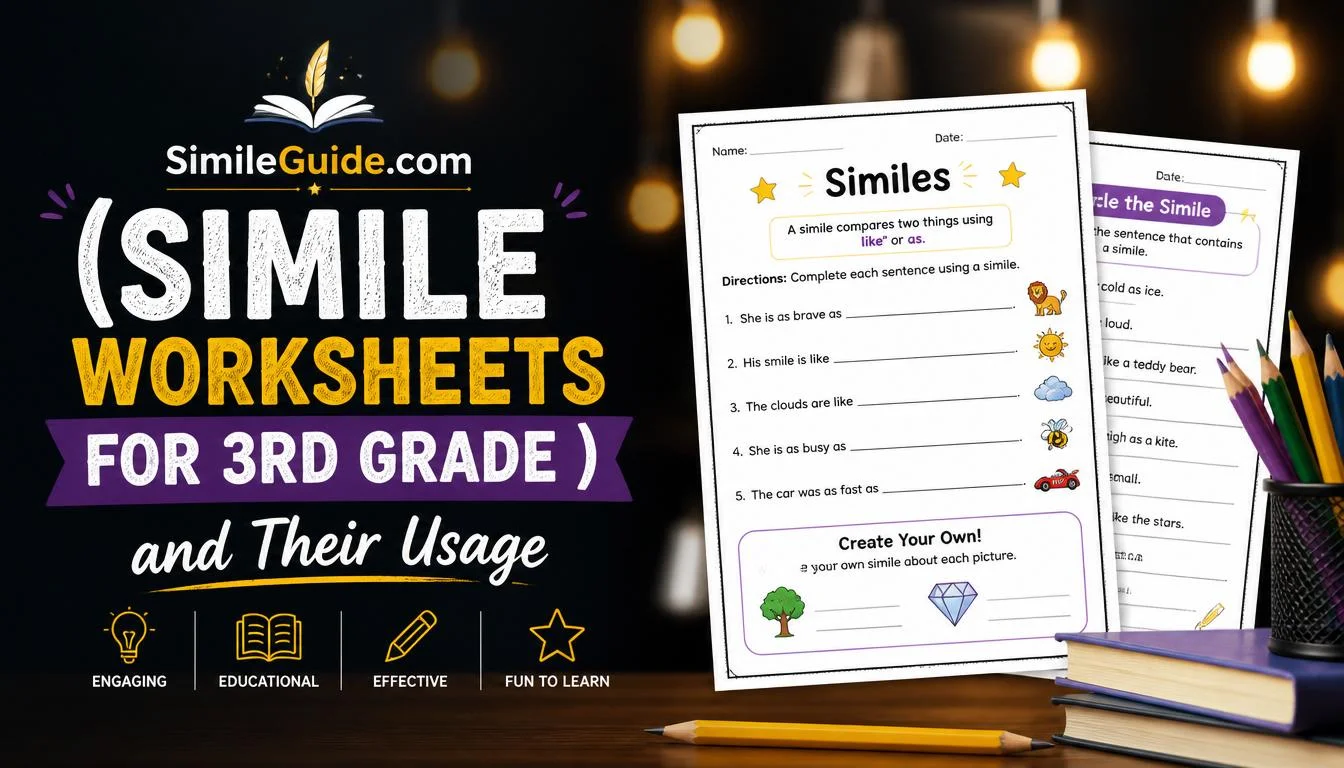
Learning figurative language can be exciting when children get the chance to read, match, complete, and create their own examples. Simile worksheets for 3rd grade are a simple way to help young learners understand how comparisons work while building vocabulary, reading comprehension, and creative writing skills.
A third grader might read, “The puppy is as playful as a bouncing ball,” and quickly understand the comparison. With the right worksheet activities, students can learn to recognize words such as like and as, identify similes, explain their meanings, and eventually create their own. Updated for 2026, this guide provides teachers, parents, and students with practical ideas for using third-grade simile worksheets in the classroom or at home.
What Are Simile Worksheets for 3rd Grade?
Simple Definition
Simile worksheets for 3rd grade are educational activities designed to help children learn about similes, a type of figurative language that compares two different things using words such as “like” or “as.”
For example:
The baby is as quiet as a mouse.
The sentence compares the baby to a mouse to show that the baby is very quiet.
Another example is:
The sun shines like a golden ball.
The sun is compared to a golden ball to help the reader imagine its appearance.
Third-grade worksheets usually introduce these ideas through short, age-appropriate activities that children can understand without complicated grammar terms.
What Skills Do These Worksheets Teach?
Well-designed worksheets can help students:
- Identify similes
- Recognize like and as comparisons
- Match similes with meanings
- Complete unfinished similes
- Choose the best comparison
- Explain figurative meanings
- Create original similes
- Improve descriptive writing
- Expand vocabulary
- Develop reading comprehension
The goal is not simply to memorize a definition. Students should learn to notice how comparisons make language more colorful and interesting.
How Do Simile Worksheets for 3rd Grade Work?
Start With Simple Comparisons
Third graders are usually introduced to familiar objects and experiences.
For example:
The snow is as white as cotton.
The child can easily understand both snow and cotton, making the comparison accessible.
Use Familiar Vocabulary
Good third-grade worksheets avoid overly complicated words.
Examples might include:
- Cat
- Dog
- Bird
- Sun
- Moon
- Ice
- Fire
- Rain
- Honey
- Feather
- Turtle
- Rabbit
These familiar subjects help children focus on understanding the simile rather than struggling with vocabulary.
Move From Recognition to Creation
A strong worksheet sequence can follow these steps:
- Find the simile.
- Identify the comparison words.
- Understand the meaning.
- Match the two parts.
- Complete the simile.
- Create a new simile.
This gradual progression helps students build confidence.
40 Simile Worksheet Examples for 3rd Grade
The following examples can be used as ideas for printable worksheets, classroom exercises, homework, or interactive activities. Each example includes a simple explanation.
1. As Busy as a Bee
Simile: She is as busy as a bee.
Meaning: She is very active and has many things to do.
Worksheet idea: Ask students to circle the two things being compared.
2. As Quiet as a Mouse
Simile: The boy was as quiet as a mouse.
Meaning: He made very little noise.
Worksheet idea: Students can draw a picture showing what the simile means.
3. Runs Like the Wind
Simile: The athlete runs like the wind.
Meaning: The athlete runs very quickly.
Worksheet idea: Ask students to choose the meaning: slow, fast, or tired.
4. As Cold as Ice
Simile: The water was as cold as ice.
Meaning: The water was extremely cold.
Worksheet idea: Students can complete: “The snow is as cold as ____.”
5. As Sweet as Honey
Simile: The mango was as sweet as honey.
Meaning: The mango had a very sweet taste.
Worksheet idea: Ask children to name another food that could be described as sweet as honey.
6. As Bright as the Sun
Simile: Her smile was as bright as the sun.
Meaning: Her smile was cheerful and full of happiness.
Worksheet idea: Students can identify whether the simile describes appearance or emotion.
7. Like a Feather
Simile: The paper was light like a feather.
Meaning: The paper was very light in weight.
Worksheet idea: Ask students to find another object that is light.
8. Like a Lion
Simile: The brave girl fought like a lion.
Meaning: She acted with great courage.
Worksheet idea: Students can write one adjective that describes the girl.
9. As Fast as a Rabbit
Simile: The little boy was as fast as a rabbit.
Meaning: He could run very quickly.
Worksheet idea: Children can draw a rabbit and write their own “as fast as” simile.
10. As Slow as a Turtle
Simile: The old car was as slow as a turtle.
Meaning: The car moved very slowly.
Worksheet idea: Students can compare two things by speed.
11. Like a Star
Simile: The diamond sparkled like a star.
Meaning: The diamond was very bright and shiny.
Worksheet idea: Students can underline the word that shows the comparison.
12. As Soft as Cotton
Simile: The blanket was as soft as cotton.
Meaning: The blanket felt very soft.
Worksheet idea: Ask students to circle the object being used for comparison.
13. Like Thunder
Simile: His voice was loud like thunder.
Meaning: His voice was very loud.
Worksheet idea: Students can draw something that makes a loud sound.
14. As Busy as an Ant
Simile: The workers were as busy as ants.
Meaning: The workers were working actively and continuously.
Worksheet idea: Ask students to explain what the ants and workers have in common.
15. Like a Fish
Simile: She swims like a fish.
Meaning: She is an excellent swimmer.
Worksheet idea: Students can write a sentence about someone who swims well.
16. As Red as a Rose
Simile: The apple was as red as a rose.
Meaning: The apple had a bright red color.
Worksheet idea: Ask students to identify the color being described.
17. Like a Rocket
Simile: The ball flew like a rocket.
Meaning: The ball moved very quickly.
Worksheet idea: Students can draw arrows to show the direction of movement.
18. As Hungry as a Wolf
Simile: After the game, I was as hungry as a wolf.
Meaning: I was extremely hungry.
Worksheet idea: Children can write about a time when they felt very hungry.
19. Like a Bird
Simile: The girl sang like a bird.
Meaning: She had a beautiful or pleasant singing voice.
Worksheet idea: Ask students what quality of the girl is being described.
20. As Busy as a Squirrel
Simile: The squirrel was as busy as a squirrel preparing for winter.
Meaning: This describes someone who is constantly active.
Worksheet idea: Students can create a simile using another animal.
21. Like a Drum
Simile: The rain sounded like a drum.
Meaning: The rain made a rhythmic tapping sound.
Worksheet idea: Ask students to describe another sound using a simile.
22. As Clear as Glass
Simile: The water was as clear as glass.
Meaning: The water was very clean and easy to see through.
Worksheet idea: Students can choose between “clear” and “muddy.”
23. Like a Snowflake
Simile: Each snowflake was delicate like a tiny flower.
Meaning: The snowflake was fragile and beautiful.
Worksheet idea: Students can draw their own delicate object.
24. As Strong as an Ox
Simile: The strong boy was as powerful as an ox.
Meaning: The boy was very strong.
Worksheet idea: Ask students to match “strong” with the correct comparison.
25. Like a Whisper
Simile: Her voice was soft like a whisper.
Meaning: Her voice was very quiet.
Worksheet idea: Students can practice reading the sentence in a soft voice.
26. As White as Snow
Simile: The rabbit was as white as snow.
Meaning: The rabbit’s fur was very white.
Worksheet idea: Ask children to find another object that can be described as white as snow.
27. Like a Rocket
Simile: The runner moved like a rocket.
Meaning: The runner moved extremely fast.
Worksheet idea: Students can replace “rocket” with another fast object.
28. As Gentle as a Dove
Simile: The nurse was as gentle as a dove.
Meaning: The nurse treated people with great care.
Worksheet idea: Ask students what the word “gentle” means.
29. Like a Rolling Wave
Simile: The clouds moved like a rolling wave.
Meaning: The clouds moved smoothly and continuously.
Worksheet idea: Students can draw the clouds described in the sentence.
30. As Hungry as a Bear
Simile: After hiking, we were as hungry as bears.
Meaning: We were extremely hungry.
Worksheet idea: Students can complete: “After playing soccer, I was as hungry as ____.”
31. Like a Flash
Simile: The rabbit disappeared like a flash.
Meaning: The rabbit moved away very quickly.
Worksheet idea: Ask students to identify the word that shows speed.
32. As Busy as a Bee
Simile: My teacher was as busy as a bee before the school event.
Meaning: The teacher had many tasks to complete.
Worksheet idea: Students can write three things a busy person might do.
33. Like a Mirror
Simile: The lake was smooth like a mirror.
Meaning: The lake’s surface was very calm and reflective.
Worksheet idea: Students can draw what they might see reflected in the lake.
34. As Light as a Feather
Simile: The balloon was as light as a feather.
Meaning: The balloon weighed very little.
Worksheet idea: Ask students to name three light objects.
35. Like a Firecracker
Simile: The children burst into the room like firecrackers.
Meaning: They entered with sudden energy and excitement.
Worksheet idea: Students can choose an adjective that describes their movement.
36. As Warm as Sunshine
Simile: The blanket was as warm as sunshine.
Meaning: The blanket felt pleasantly warm and comforting.
Worksheet idea: Students can describe something else that feels warm.
37. Like a Sleeping Cat
Simile: The baby slept like a peaceful cat.
Meaning: The baby slept quietly and comfortably.
Worksheet idea: Ask students to create another simile for sleeping.
38. As Happy as a Bird
Simile: The children were as happy as birds in spring.
Meaning: The children were joyful and cheerful.
Worksheet idea: Students can write a sentence about something that makes them happy.
39. Like a Gentle Breeze
Simile: The wind moved like a gentle breeze.
Meaning: The wind moved softly and peacefully.
Worksheet idea: Ask students to choose a word that describes the wind.
40. As Busy as a Beaver
Simile: The students were as busy as beavers during the project.
Meaning: The students were working hard and staying active.
Worksheet idea: Children can write their own sentence using an animal comparison.
Examples of Simile Worksheets for 3rd Grade in Everyday Learning
Worksheet Type 1: Circle the Simile
Students read several sentences and circle the ones that contain similes.
Example:
- The dog ran quickly.
- The dog ran like the wind.
- The dog is brown.
- The dog was as playful as a puppy.
This activity helps children recognize figurative language.
Worksheet Type 2: Fill in the Blank
Students complete a simile.
The snow is as white as ________.
Possible answer:
cotton
Or:
snow is as white as a cloud.
The goal is to encourage creative thinking.
Worksheet Type 3: Match the Pairs
Students match the beginning of a simile with the correct ending.
| Beginning | Ending |
|---|---|
| As busy as | a bee |
| As slow as | a turtle |
| As white as | snow |
| As sweet as | honey |
| As strong as | an ox |
This activity helps students understand common comparisons.
Worksheet Type 4: Explain the Meaning
Students read:
He runs like the wind.
Then answer:
What does this mean?
Answer: He runs very fast.
This teaches children that similes often have a figurative meaning.
Worksheet Type 5: Draw the Simile
Give students a sentence such as:
The moon was like a silver ball.
Ask them to draw what they imagine.
This activity combines reading comprehension with creativity.
Famous or Popular Simile Examples for 3rd Grade
Some simple similes are commonly taught because they are easy for young learners to understand.
“As Busy as a Bee”
This means someone is very active or has many things to do.
My mom was as busy as a bee getting ready for the party.
“As Slow as a Turtle”
This describes something moving very slowly.
The old bus was as slow as a turtle.
“Runs Like the Wind”
This means someone runs very quickly.
The athlete runs like the wind.
“As Sweet as Honey”
This can describe a sweet taste or a kind personality.
The little girl’s voice was as sweet as honey.
“As White as Snow”
This describes something that is extremely white.
The rabbit was as white as snow.
Simile Worksheets for 3rd Grade vs. Related Concepts
Understanding the difference between similes and other forms of language is important for third-grade students.
| Concept | Simple Definition | Example |
|---|---|---|
| Simile | Compares two things using “like” or “as” | The cat is as quiet as a mouse. |
| Metaphor | Says one thing is another | The classroom was a zoo. |
| Literal Language | Says exactly what something means | The cat is quiet. |
| Idiom | A phrase with a special figurative meaning | It’s raining cats and dogs. |
| Personification | Gives human qualities to non-human things | The wind whispered. |
Simile vs. Metaphor
A third grader can remember the difference this way:
Simile:
The classroom was like a zoo.
Metaphor:
The classroom was a zoo.
The simile uses like, while the metaphor makes a direct comparison.
How to Use or Create Simile Worksheets for 3rd Grade
Step 1: Choose a Simple Learning Goal
Decide whether students will practice:
- Finding similes
- Understanding meanings
- Matching comparisons
- Completing sentences
- Creating original similes
Step 2: Select Age-Appropriate Vocabulary
Use things children already know.
Good choices include:
- Animals
- Food
- Weather
- School
- Sports
- Toys
- Nature
- Family
- Everyday objects
Step 3: Begin With Recognition
Start with simple questions:
Which sentence contains a simile?
This builds confidence before students begin creating their own.
Step 4: Add Creative Practice
Ask students to complete:
The baby is as quiet as ________.
There may be several possible answers. Encourage creative but sensible comparisons.
Step 5: Ask Students to Explain
After creating a simile, ask:
What does your simile mean?
This ensures students understand the figurative meaning instead of simply filling in a blank.
From real-life writing experience, children often become much better at figurative language when they are encouraged to draw, explain, and discuss their comparisons rather than only memorizing definitions.
Common Mistakes Students Make With Simile Worksheets
1. Forgetting “Like” or “As”
A simile generally uses a comparison word.
The boy runs a cheetah. ❌
The boy runs like a cheetah. ✅
The first sentence does not make the comparison clearly.
2. Taking the Simile Literally
When students read:
She is as busy as a bee.
They should understand that the person is very busy, not that she is literally a bee.
3. Choosing a Comparison That Does Not Fit
For example:
The turtle was as fast as a turtle.
This does not create a useful comparison because turtles are known for being slow.
A better example is:
The turtle was as slow as a snail.
4. Using Unfamiliar Vocabulary
Third graders learn best when examples are clear and relatable.
Instead of using rare or complicated objects, choose familiar comparisons such as snow, honey, sunshine, or animals.
5. Thinking Every “Like” Is a Simile
The word like does not always create a simile.
For example:
I like apples.
This is not a simile.
But:
Her cheeks were red like apples.
This is a simile because it compares two things.
Practical Uses of Simile Worksheets for 3rd Grade
For Classroom Learning
Teachers can use worksheets for:
- Morning work
- English lessons
- Homework
- Independent practice
- Small-group activities
- Review sessions
- Assessment preparation
For Parents
Parents can use simple simile activities at home to make language learning fun.
For example, ask:
“Can you think of something as soft as a feather?”
Children might answer:
A pillow!
This turns everyday conversation into a mini language lesson.
For Creative Writing
Students can use similes when writing:
- Short stories
- Poems
- Personal narratives
- Descriptive paragraphs
- School assignments
A sentence such as:
The playground was as busy as a beehive.
creates a much stronger image than:
The playground was busy.
For Interactive Learning
Teachers can turn worksheet questions into games.
For example:
- Write half a simile on the board.
- Let students suggest possible endings.
- Discuss which comparisons make sense.
- Let students vote for their favorite.
- Have everyone write an original sentence.
Internal Link Ideas for Related Topics
If you’re creating a website focused on English education and figurative language, consider adding internal links to:
- What Is a Simile?
- Simile vs. Metaphor for Kids
- Simile Worksheets for 4th Grade
- Metaphor Worksheets for 3rd Grade
- Figurative Language Worksheets
- Simile Examples for Kids
- Fun Simile Activities for Students
- Simile and Metaphor Exercises
- Personification Worksheets for Kids
- Types of Figurative Language
These topics can help students move from basic recognition to more advanced writing skills.
Frequently Asked Questions About Simile Worksheets for 3rd Grade
What Are Simile Worksheets for 3rd Grade?
They are educational worksheets that help third-grade students understand and practice similes. Activities may include identifying, matching, completing, explaining, and creating comparisons.
What Is a Simple Simile for a 3rd Grader?
A simple example is “The baby is as quiet as a mouse.” The simile compares the baby’s quietness to a mouse.
How Can I Teach Similes to a 3rd Grader?
Start with a simple definition: A simile compares two different things using “like” or “as.” Then use familiar examples involving animals, food, weather, and everyday objects.
Are Simile Worksheets Good for Homework?
Yes. Short worksheet activities can reinforce classroom lessons and give children extra practice. Keep the questions age-appropriate and include a mix of recognition and creative exercises.
How Can Students Create Their Own Similes?
Ask students to choose an object, think of one quality it has, and compare it with something else. For example, if a student chooses “snow,” they might write, “The snow was as white as cotton.”
Conclusion: Making Simile Learning Fun for 3rd Graders
Simile worksheets for 3rd grade give children a practical and enjoyable way to explore figurative language. By identifying comparisons, matching meanings, completing sentences, and creating original examples, students can develop stronger vocabulary and more creative writing skills.
The best worksheets make learning active. Instead of simply memorizing that a simile uses “like” or “as,” children should have opportunities to draw what they imagine, explain what comparisons mean, and connect figurative language to their everyday experiences. Updated for 2026, these activities can easily be adapted for classroom lessons, home learning, printable exercises, or digital practice.
Encourage students to look for similes in books, songs, conversations, and their own writing. Once they begin noticing comparisons around them, they can start creating their own. With regular practice, third graders can turn simple sentences into colorful descriptions that make their writing more expressive, imaginative, and fun.
DISCOVER MORE ARTICLES
Simile for Familiar: 40 Creative Examples and Meanings 2026
Simile for Creaking Floorboards: 40 Creative Examples 2026
Simile for Voice: 40 Creative Examples and Meanings 2026
