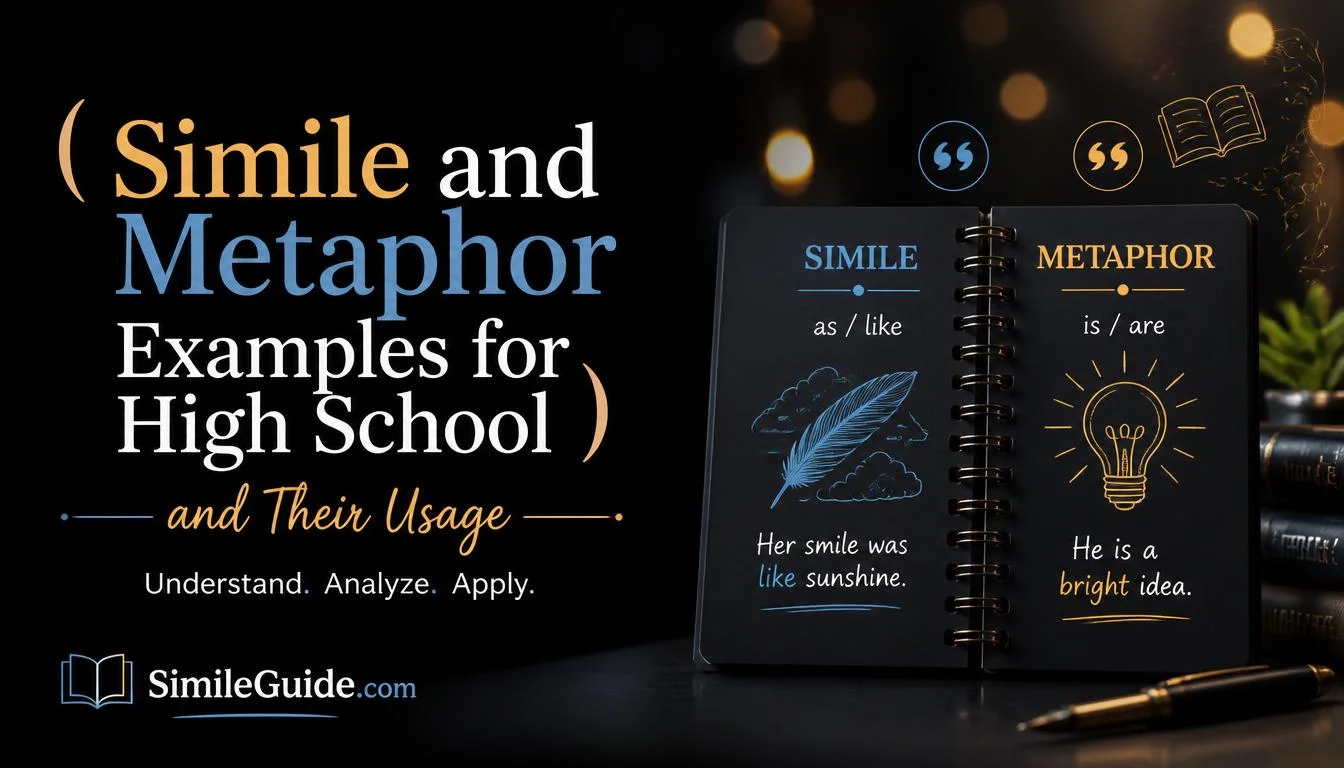
Learning simile and metaphor examples for high school can make English much more interesting. Instead of simply saying that someone is fast, you can say, “He runs like the wind.” Instead of saying that a difficult exam was challenging, you might write, “The exam was a mountain.”
These comparisons help readers picture an idea, feeling, person, or situation more clearly. You will find similes and metaphors in high school essays, poems, stories, speeches, books, social media captions, and everyday conversations.
In everyday conversations, people often use similes and metaphors to make ordinary descriptions more expressive. From real-life writing experience, a simple comparison can sometimes communicate an idea more effectively than several plain sentences.
Whether you are a student preparing for an English test, a writer looking for creative ideas, or a reader who wants a quick explanation, this guide provides 40 simile and metaphor examples for high school with simple meanings and explanations.
What Are Simile and Metaphor Examples for High School?
What Is a Simile?
A simile is a figure of speech that compares two different things using words such as “like” or “as.”
Example: “The girl was as busy as a bee.”
Meaning: The girl was extremely busy and active.
The girl is not literally a bee. The comparison highlights how much work she was doing.
Another example is:
“His voice was like thunder.”
Meaning: His voice was very loud and powerful.
Similes are useful because they create an easy mental picture for the reader.
What Is a Metaphor?
A metaphor is a figure of speech that compares two different things directly without using “like” or “as.”
Example: “The classroom was a zoo.”
Meaning: The classroom was very noisy, crowded, or chaotic.
The classroom is not actually a zoo. The writer uses the image of a zoo to communicate the atmosphere.
Another example is:
“Knowledge is power.”
Meaning: Knowledge can give people strength, confidence, opportunities, and influence.
Simile and Metaphor Difference
The easiest way to remember the difference is:
- Simile: Uses like or as to make a comparison.
- Metaphor: Makes the comparison directly.
- Simile example: “She shines like a star.”
- Metaphor example: “She is a star.”
Both devices make writing more descriptive, but they create comparisons in slightly different ways.
How Similes and Metaphors Work
How Similes Work
A simile connects one thing to another based on a shared quality.
For example:
“The student was as quiet as a mouse.”
Meaning: The student was extremely quiet.
The writer compares the student’s quietness to the quiet behavior commonly associated with a mouse.
Another example:
“The runner moved like lightning.”
Meaning: The runner moved extremely quickly.
The comparison makes the description more vivid than simply saying, “The runner was fast.”
How Metaphors Work
Metaphors make comparisons more directly.
For example:
“My homework is a mountain.”
Meaning: My homework feels extremely difficult or overwhelming.
The homework is not literally a mountain. The metaphor gives the reader an image of something large and difficult to overcome.
Another example:
“Her heart was ice.”
Meaning: She seemed emotionally cold or unwilling to show affection.
Why High School Students Need These Literary Devices
Understanding simile and metaphor examples for high school can help students:
- Understand poetry and literature
- Improve descriptive essays
- Write better stories
- Analyze authors’ language
- Create stronger speeches
- Improve creative writing
- Understand figurative language questions
- Make social media captions more interesting
40 Simile and Metaphor Examples for High School
Below are practical examples organized around school, emotions, people, nature, technology, and everyday experiences.
1. As Busy as a Bee — Simile
Example: “I was as busy as a bee during exam week.”
Meaning: I was extremely busy with studying, assignments, and other responsibilities.
The bee represents constant activity and hard work.
2. The Classroom Was a Zoo — Metaphor
Example: “The classroom was a zoo after the teacher left.”
Meaning: The classroom became very noisy, chaotic, or difficult to control.
The metaphor compares a chaotic classroom to a busy zoo.
3. Runs Like the Wind — Simile
Example: “The athlete runs like the wind.”
Meaning: The athlete runs extremely fast.
The wind creates an image of speed and movement.
4. Knowledge Is Power — Metaphor
Example: “Knowledge is power.”
Meaning: Having knowledge can give people confidence, opportunities, and influence.
This metaphor shows the value of education.
5. As Quiet as a Mouse — Simile
Example: “The students were as quiet as mice during the test.”
Meaning: The students were extremely quiet.
The comparison emphasizes complete silence.
6. My Backpack Is a Brick — Metaphor
Example: “My backpack is a brick today.”
Meaning: My backpack feels extremely heavy.
The metaphor compares the weight of the backpack to a heavy brick.
7. Her Smile Was Sunshine — Metaphor
Example: “Her smile was sunshine on a difficult morning.”
Meaning: Her smile made people feel happy, warm, or hopeful.
Sunshine represents happiness and positivity.
8. As Brave as a Lion — Simile
Example: “The student was as brave as a lion during the presentation.”
Meaning: The student showed great courage.
A lion is commonly associated with strength and bravery.
9. His Words Were Arrows — Metaphor
Example: “His angry words were arrows.”
Meaning: His words caused emotional pain.
The metaphor compares hurtful words to arrows because both can cause damage.
10. Like a Shooting Star — Simile
Example: “Her idea appeared like a shooting star.”
Meaning: Her idea appeared suddenly and attracted attention.
A shooting star creates an image of something bright, quick, and noticeable.
11. The Exam Was a Mountain — Metaphor
Example: “The final exam was a mountain to climb.”
Meaning: The exam seemed very difficult and required considerable effort.
The mountain represents a major challenge.
12. As Cold as Ice — Simile
Example: “His response was as cold as ice.”
Meaning: His response was unfriendly, emotionless, or distant.
Ice creates an image of coldness and lack of warmth.
13. Her Voice Was Music — Metaphor
Example: “Her voice was music to my ears.”
Meaning: Her voice sounded very pleasant or comforting.
Music represents something enjoyable and beautiful to hear.
14. Like a Fish Out of Water — Simile
Example: “I felt like a fish out of water at my new school.”
Meaning: I felt uncomfortable, unfamiliar, or out of place.
The comparison shows how difficult it can feel to enter a new environment.
15. Time Is a Thief — Metaphor
Example: “Time is a thief that steals our best moments.”
Meaning: Time passes quickly and takes moments away from us.
The metaphor makes the passing of time feel more personal and powerful.
16. As Fast as Lightning — Simile
Example: “She completed the quiz as fast as lightning.”
Meaning: She completed the quiz extremely quickly.
Lightning represents great speed.
17. My Mind Is a Maze — Metaphor
Example: “My mind is a maze before an important exam.”
Meaning: I feel confused and have many complicated thoughts.
A maze represents confusion and difficulty finding a clear direction.
18. Like Walking on Air — Simile
Example: “After receiving the scholarship, she felt like she was walking on air.”
Meaning: She felt extremely happy and excited.
The comparison creates an image of someone feeling light and joyful.
19. The City Is a Jungle — Metaphor
Example: “The city is a jungle during rush hour.”
Meaning: The city becomes crowded, busy, competitive, and chaotic.
The jungle represents an environment that can be difficult to navigate.
20. As Gentle as a Breeze — Simile
Example: “Her voice was as gentle as a breeze.”
Meaning: Her voice was soft, calm, and pleasant.
The breeze creates an image of peaceful movement.
21. Dreams Are Seeds — Metaphor
Example: “Dreams are seeds that grow through hard work.”
Meaning: Dreams need effort, patience, and care to become reality.
Seeds represent potential and growth.
22. He Remembers Like a Computer — Simile
Example: “He remembers facts like a computer.”
Meaning: He has an excellent memory.
The comparison emphasizes his ability to remember information accurately.
23. The Library Is a Treasure Chest — Metaphor
Example: “The library is a treasure chest full of knowledge.”
Meaning: The library contains valuable information and ideas.
Books are compared with treasures because they provide valuable knowledge.
24. As Stubborn as a Mule — Simile
Example: “My brother is as stubborn as a mule.”
Meaning: My brother refuses to change his opinion easily.
The mule is traditionally associated with stubbornness.
25. Her Heart Was a Fortress — Metaphor
Example: “After being hurt, her heart became a fortress.”
Meaning: She became emotionally guarded and difficult to approach.
A fortress represents protection and emotional barriers.
26. Like a Candle in the Dark — Simile
Example: “His advice was like a candle in the dark.”
Meaning: His advice provided guidance during a difficult situation.
The candle represents hope, direction, and understanding.
27. The Exam Room Was a Pressure Cooker — Metaphor
Example: “The exam room felt like a pressure cooker.”
Meaning: Everyone in the room felt extremely stressed and tense.
A pressure cooker represents intense pressure.
28. As Clear as Glass — Simile
Example: “Her explanation was as clear as glass.”
Meaning: Her explanation was very easy to understand.
The comparison emphasizes clarity.
29. Knowledge Is a Key — Metaphor
Example: “Knowledge is a key that opens many doors.”
Meaning: Education can create opportunities and help people reach their goals.
The key represents access and opportunity.
30. High School Is a Roller Coaster — Metaphor
Example: “High school is a roller coaster of emotions.”
Meaning: High school can involve many emotional highs and lows.
The roller coaster represents changing experiences.
31. As Hungry as a Wolf — Simile
Example: “After football practice, I was as hungry as a wolf.”
Meaning: I was extremely hungry.
The wolf represents strong hunger.
32. Failure Is a Teacher — Metaphor
Example: “Failure is a teacher if you learn from it.”
Meaning: Mistakes can teach valuable lessons.
Failure is presented as a teacher because it can provide useful experience.
33. Like a Puzzle — Simile
Example: “Writing an essay is like solving a puzzle.”
Meaning: Writing requires different ideas to fit together logically.
The puzzle represents organization and problem-solving.
34. The Internet Is a Highway — Metaphor
Example: “The internet is a highway connecting people around the world.”
Meaning: The internet allows information and communication to travel between distant places.
The highway represents connection and movement.
35. As Light as a Feather — Simile
Example: “The new laptop was as light as a feather.”
Meaning: The laptop was very easy to carry.
The feather represents extreme lightness.
36. Her Words Were a Bridge — Metaphor
Example: “Her kind words were a bridge between the two friends.”
Meaning: Her words helped repair their relationship.
The bridge represents connection and reconciliation.
37. Like Thunder — Simile
Example: “The audience’s applause sounded like thunder.”
Meaning: The applause was extremely loud and powerful.
Thunder creates an image of tremendous sound.
38. Social Media Is a Mirror — Metaphor
Example: “Social media can be a mirror of how people present themselves.”
Meaning: Social media can reflect the image people choose to show others.
The mirror represents reflection and self-presentation.
39. As Strong as an Ox — Simile
Example: “The young athlete was as strong as an ox.”
Meaning: The athlete was extremely strong.
The ox represents physical strength.
40. Education Is a Bridge — Metaphor
Example: “Education is a bridge between dreams and opportunity.”
Meaning: Education can help people move from their goals toward real opportunities.
The bridge represents progress and connection.
Simile and Metaphor Examples in Everyday Life
At School
Students naturally use figurative language when discussing school.
“This assignment is a mountain.”
Meaning: The assignment feels difficult or overwhelming.
With Friends
“My best friend is like a sister to me.”
Meaning: My friend is extremely close and important to me.
Talking About Technology
“My phone is my lifeline.”
Meaning: I depend heavily on my phone for communication and everyday activities.
Describing Food
“The dessert was as sweet as honey.”
Meaning: The dessert was extremely sweet.
Describing Emotions
“My heart was racing like a drum.”
Meaning: I was very nervous or excited.
Famous and Popular Simile and Metaphor Examples
The World Is a Stage
“The world is a stage.”
Meaning: Life can be viewed as a performance in which people play different roles.
This is a famous metaphor associated with Shakespeare’s writing.
Life Is Like a Box of Chocolates
“Life is like a box of chocolates.”
Meaning: Life contains unexpected experiences and outcomes.
This is a widely recognized simile from popular culture.
A Blanket of Snow
“A blanket of snow covered the town.”
Meaning: Snow covered the ground and buildings like a blanket covers something.
This metaphor creates a visual image of a snowy landscape.
Simile vs. Metaphor vs. Other Literary Devices
Comparison Table
| Device | Definition | Example |
|---|---|---|
| Simile | Compares two things using like or as | “She shines like a star.” |
| Metaphor | Makes a direct comparison | “She is a star.” |
| Personification | Gives human qualities to nonhuman things | “The wind whispered.” |
| Hyperbole | Uses deliberate exaggeration | “I have a million assignments.” |
| Idiom | Expression with a special nonliteral meaning | “Break the ice.” |
| Alliteration | Repeats beginning sounds | “Busy bees buzzed.” |
Simile vs. Personification
Simile: “The wind was like a whisper.”
Meaning: The wind sounded soft and quiet.
Personification: “The wind whispered through the trees.”
Meaning: The wind is given the human action of whispering.
Metaphor vs. Hyperbole
Metaphor: “My backpack is a mountain.”
Meaning: My backpack feels very large or heavy.
Hyperbole: “My backpack weighs a thousand tons.”
Meaning: The backpack is being deliberately exaggerated as extremely heavy.
How to Create Your Own Similes and Metaphors
Step 1: Choose an Idea
Start with something you want to describe.
For example:
Fear
Step 2: Identify Its Main Quality
Ask yourself what fear feels like.
It might feel:
- Dark
- Heavy
- Sudden
- Powerful
- Cold
- Overwhelming
Step 3: Create a Simile
Add like or as.
“Fear spread through me like darkness.”
Meaning: Fear gradually filled my thoughts and emotions.
Step 4: Create a Metaphor
Make the comparison direct.
“Fear was a darkness inside me.”
Meaning: Fear felt deep, powerful, and difficult to escape.
Step 5: Check Your Comparison
Ask yourself:
- Does the comparison make sense?
- Does it create a clear image?
- Does it fit the situation?
- Does it make the sentence more interesting?
If the answer is yes, your figurative language is probably effective.
Practical Uses of Similes and Metaphors
In Essays
Figurative language can make descriptive and personal essays more engaging.
“My first day of high school was a roller coaster of emotions.”
Meaning: The writer experienced many different feelings during the day.
In Poetry
Poetry often uses comparisons to communicate emotions.
“Your voice is a warm summer breeze.”
Meaning: The person’s voice feels peaceful and comforting.
In Creative Writing
Writers use metaphors and similes to help readers imagine characters and settings.
“The old house stood like a tired giant.”
Meaning: The house looked large, old, and worn down.
In Speeches
A strong metaphor can make an important message memorable.
“Education is the bridge between dreams and opportunity.”
Meaning: Education can help people turn goals into real possibilities.
In Social Media Captions
Figurative language can make short captions more expressive.
“Chasing dreams like they are sunsets.”
Meaning: The person is actively pursuing beautiful or meaningful goals.
In Daily Conversation
People use figurative language naturally.
“That presentation felt like a marathon.”
Meaning: The presentation felt long, tiring, or demanding.
Common Mistakes People Make With Similes and Metaphors
Mistake 1: Confusing Similes and Metaphors
Simile: “He is as busy as a bee.”
Metaphor: “He is a bee during exam week.”
The first uses as, while the second makes a direct comparison.
Mistake 2: Creating Meaningless Comparisons
Weak:
“My homework is like a refrigerator.”
The reader may not understand the connection.
Better:
“My homework is like a mountain because it seems impossible to finish.”
Mistake 3: Using Too Many Comparisons
Using a simile or metaphor in every sentence can make writing feel forced.
Use figurative language when it adds meaning, emotion, or imagery.
Mistake 4: Taking Metaphors Literally
If someone writes:
“The classroom was a zoo.”
They do not mean that actual animals were inside the classroom.
Meaning: The classroom was noisy, chaotic, or crowded.
Mistake 5: Using Clichés Too Often
Common comparisons can be useful, but original comparisons can make your writing more memorable.
Instead of always writing “as busy as a bee,” try creating a fresh comparison based on the situation.
Tips for Writing Better Similes and Metaphors
1. Choose Clear Images
Use objects and experiences that your readers can easily imagine.
2. Be Specific
Instead of:
“She moved like an animal.”
Try:
“She moved like a hunting cat.”
Meaning: She moved quietly, carefully, and quickly.
3. Match the Mood
A peaceful scene might need a gentle comparison, while an action scene might need something powerful.
4. Avoid Overusing Figurative Language
One excellent metaphor can be more effective than five unnecessary ones.
5. Make the Comparison Meaningful
Your comparison should help the reader understand something about the subject.
6. Read Your Writing Aloud
Reading your sentence aloud can help you notice awkward or confusing comparisons.
Internal Link Ideas for Related Topics
If you are creating an educational website about literary devices, you can connect this article to related resources such as:
- What Is a Simile?
- What Is a Metaphor?
- Simile vs. Metaphor
- Examples of Figurative Language
- Personification Examples
- Hyperbole Examples
- Simile Examples for Students
- Metaphor Examples for Students
- Literary Devices and Their Meanings
- Figurative Language in Poetry
These internal links can help readers discover related lessons and improve your site’s overall topic structure.
Frequently Asked Questions
What is a simile for high school students?
A simile is a comparison between two different things using “like” or “as.”
Example: “The student was as quiet as a mouse.”
Meaning: The student was extremely quiet.
What is a metaphor for high school students?
A metaphor directly compares two different things without using “like” or “as.”
Example: “The classroom was a zoo.”
Meaning: The classroom was noisy or chaotic.
What is the easiest way to remember the difference?
Look for like or as.
Simile: “She is like a star.”
Metaphor: “She is a star.”
Why are similes and metaphors important in writing?
They make writing more visual, creative, emotional, and memorable. They help readers understand ideas by connecting them to familiar images.
Can I use similes and metaphors in school essays?
Yes. They can work especially well in descriptive, narrative, personal, and creative writing. In formal academic writing, use them carefully and only when they strengthen your point.
Conclusion
Simile and metaphor examples for high school help students understand one of the most useful areas of figurative language. A simile makes a comparison using “like” or “as,” while a metaphor makes a direct comparison.
These literary devices are useful far beyond English class. You can use them in essays, poems, stories, speeches, captions, social media posts, and everyday conversations to make your language more vivid and memorable.
The best way to master similes and metaphors is to practice. Choose something familiar—a friend, classroom, emotion, hobby, place, or experience—and create one simile and one metaphor about it. The more you experiment, the easier it becomes to use figurative language naturally and confidently.
DISCOVER MORE ARTICLES
Simile for Books: 40 Creative Examples and Meanings 2026
Simile for Cars: 40 Creative Examples and Meanings 2026
Simile for 3rd Grade: 40 Easy Examples and Meanings 2026
