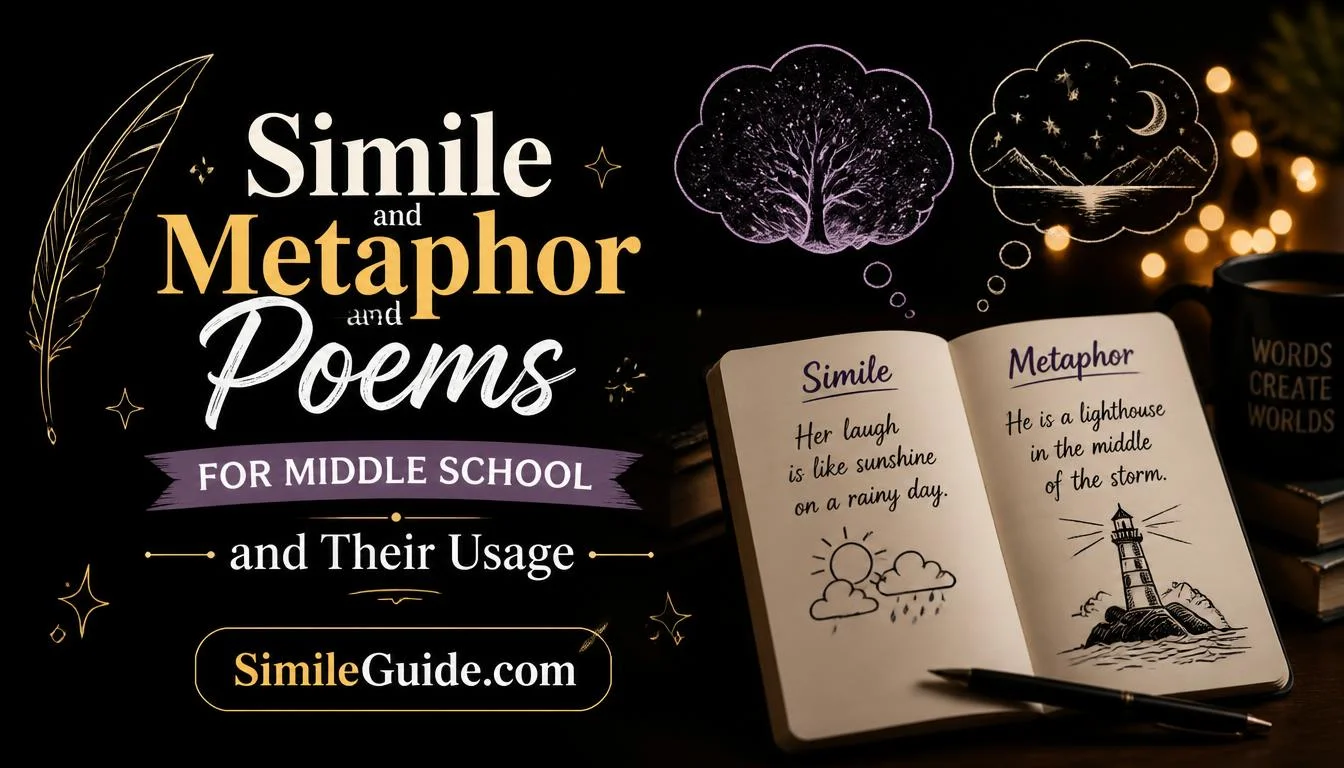
Poetry becomes much more interesting when ordinary words create extraordinary pictures. Simile and metaphor poems for middle school help students understand how writers compare ideas, describe emotions, and make abstract thoughts easier to imagine.
A simile uses words such as “like” or “as” to compare two different things, while a metaphor says that one thing is another to create a powerful comparison. For middle school students, learning these literary devices can make reading more enjoyable and writing more creative.
For example, a student might write, “The moon is like a silver coin in the sky.” This is a simile. A metaphor could say, “The moon is a silver coin in the sky.” Both create a mental picture, but they use comparison in different ways.
From real-life writing experience, these devices are among the easiest ways to make a simple sentence more vivid. Whether students are writing a poem about friendship, school, nature, fear, or social media, similes and metaphors can help their words stand out.
Updated for 2026, this guide explains simile and metaphor poems for middle school in simple language, with practical examples, creative writing ideas, comparisons, common mistakes, and 40 original examples students can study and use as inspiration.
1. What Are Simile and Metaphor Poems for Middle School?
Simple Definition
Simile and metaphor poems for middle school are poems that use comparisons to create vivid images, express emotions, and communicate ideas in creative ways.
A simile compares two different things using words such as:
- like
- as
- as if
- resembles
A metaphor makes a direct comparison without using “like” or “as.”
Example of a Simile
“The classroom was as busy as a beehive.”
This compares a busy classroom to a beehive. The reader imagines students moving around, talking, and working.
Example of a Metaphor
“The classroom was a beehive.”
This does not mean the classroom is literally a beehive. It suggests that the room was extremely active and energetic.
Why Are They Important in Middle School Poetry?
Middle school is an important time for students to develop stronger reading and writing skills. Similes and metaphors help students:
- Create vivid mental pictures
- Express difficult emotions
- Make poems more interesting
- Improve descriptive writing
- Understand figurative language
- Develop creativity
- Analyze poetry more effectively
In everyday conversations, people often use similes and metaphors to explain feelings and experiences that are difficult to describe directly.
For example, someone might say, “My homework is a mountain.” The person does not mean that the homework is a real mountain. The metaphor shows that the work feels huge and difficult.
2. How Simile and Metaphor Poems Work
How Similes Work
A simile makes a comparison using connecting words.
Example: “Her smile was like sunshine after rain.”
The smile is compared to sunshine because both can create feelings of warmth and happiness.
A simile usually follows patterns such as:
- Something is like something else.
- Something is as + adjective + as something else.
How Metaphors Work
A metaphor creates a direct comparison.
Example: “Her smile was sunshine after rain.”
The writer does not use “like” or “as.” Instead, the smile is described as sunshine to suggest happiness, comfort, and hope.
The Role of Imagery
Both devices create imagery, which means language that helps readers imagine something through their senses.
Compare these two sentences:
Plain: The student was nervous.
Figurative: The student’s heart was a drum pounding before the test.
The second sentence gives readers a stronger sense of the student’s nervousness.
The Role of Emotion
Poetry often focuses on emotions that are hard to explain directly.
A writer might say:
“Fear is a shadow following me.”
This metaphor makes fear seem like something that constantly stays nearby.
3. Examples of Simile and Metaphor Poems in Everyday Life
Similes and metaphors are not limited to English class. People use them in ordinary communication all the time.
In School
“The test was as tough as climbing a mountain.”
This simile shows that the test felt extremely difficult.
In Friendship
“My best friend is my anchor.”
This metaphor suggests that the friend provides stability and support.
In Sports
“He moved like lightning across the field.”
The simile emphasizes how quickly the athlete moved.
In Social Media Captions
“Today is a fresh page.”
This metaphor suggests a new beginning or opportunity.
In Daily Conversation
“I have a million things to do.”
This is an exaggerated metaphorical expression showing that someone is extremely busy.
In Personal Writing
“My thoughts were clouds drifting across the sky.”
This metaphor suggests thoughts that are constantly changing or wandering.
4. 40 Simile and Metaphor Poem Examples for Middle School
The following examples are original, student-friendly ideas that can inspire classroom assignments, poetry practice, and creative writing.
1. The Moon
Simile: “The moon shines like a lantern above the sleeping town.”
Meaning: The moon is compared to a lantern because both provide light in darkness.
2. The Sun
Metaphor: “The sun is a golden torch lighting the morning.”
Meaning: The metaphor presents the sun as a powerful source of light.
3. Friendship
Simile: “Friendship is like a bridge over troubled water.”
Meaning: The comparison suggests that friendship helps people overcome difficult times.
4. A Best Friend
Metaphor: “My best friend is my compass.”
Meaning: The friend is compared to a compass because they help the speaker find direction.
5. School
Simile: “The school hallway buzzed like a busy marketplace.”
Meaning: This shows that the hallway was crowded, noisy, and full of activity.
6. Homework
Metaphor: “My homework is a mountain waiting to be climbed.”
Meaning: The mountain represents a large amount of challenging work.
7. A Test
Simile: “The exam stared at me like a locked door.”
Meaning: The simile expresses the student’s feeling that the test was difficult to understand.
8. Courage
Metaphor: “Courage is a small flame inside the heart.”
Meaning: The flame represents inner strength and bravery.
9. Fear
Metaphor: “Fear is a shadow that follows my footsteps.”
Meaning: Fear is shown as something that stays close and difficult to escape.
10. Happiness
Simile: “Happiness spread through the room like sunlight.”
Meaning: Happiness is compared to sunlight because it brightens the surroundings.
11. Sadness
Metaphor: “Sadness is a gray cloud above my thoughts.”
Meaning: The cloud represents a heavy and gloomy emotional state.
12. Anger
Simile: “His anger burned like a fire in the summer heat.”
Meaning: The comparison emphasizes the intensity of his anger.
13. Kindness
Metaphor: “Kindness is a warm blanket on a cold day.”
Meaning: Kindness is compared to comfort that makes difficult moments easier.
14. Knowledge
Metaphor: “Knowledge is a key that opens countless doors.”
Meaning: The doors represent opportunities that education can create.
15. Reading
Simile: “A good book is like a window into another world.”
Meaning: Reading allows people to experience places, ideas, and lives beyond their own.
16. Imagination
Metaphor: “Imagination is a rocket waiting for launch.”
Meaning: The metaphor suggests that imagination can take the mind anywhere.
17. Dreams
Simile: “Dreams float like balloons above my worries.”
Meaning: Dreams are presented as hopeful thoughts that rise above problems.
18. Time
Metaphor: “Time is a river that never turns back.”
Meaning: The river represents the constant movement of time.
19. Morning
Simile: “Morning arrived like a fresh beginning.”
Meaning: The comparison shows that a new day can bring new possibilities.
20. Night
Metaphor: “Night is a blanket covering the busy world.”
Meaning: The blanket suggests darkness and peaceful rest.
21. Rain
Simile: “The rain tapped the roof like tiny fingers.”
Meaning: The comparison helps readers imagine the sound of raindrops.
22. Wind
Metaphor: “The wind is a restless traveler.”
Meaning: The wind is described as a traveler because it constantly moves from place to place.
23. Storm
Simile: “The storm roared like a giant waking from sleep.”
Meaning: The simile emphasizes the loud and powerful sound of the storm.
24. Trees
Metaphor: “The trees are guardians of the forest.”
Meaning: The trees are presented as protectors of the natural environment.
25. Ocean
Simile: “The ocean glittered like a blanket of diamonds.”
Meaning: The comparison describes sunlight sparkling across the water.
26. River
Metaphor: “The river is a silver ribbon through the valley.”
Meaning: The river is compared to a ribbon because of its long, winding appearance.
27. Autumn
Simile: “The leaves fell like colorful pieces of paper.”
Meaning: The comparison creates a visual image of leaves drifting to the ground.
28. Winter
Metaphor: “Winter is a quiet artist painting the world white.”
Meaning: Snow is imagined as the work of an artist creating a white landscape.
29. Summer
Simile: “Summer felt as warm as a glowing fireplace.”
Meaning: The comparison emphasizes the season’s heat and warmth.
30. Spring
Metaphor: “Spring is the Earth’s awakening.”
Meaning: Spring is described as a time when nature becomes alive again.
31. Music
Simile: “The melody moved like a bird through the air.”
Meaning: The comparison suggests that the music felt light, free, and graceful.
32. Creativity
Metaphor: “Creativity is a garden of endless ideas.”
Meaning: The garden represents a place where new ideas can continually grow.
33. Memory
Simile: “The memory returned like an old song.”
Meaning: The memory is compared to a familiar song because both can suddenly bring back the past.
34. Hope
Metaphor: “Hope is a star in the darkest sky.”
Meaning: The star represents a small but powerful source of encouragement.
35. Change
Simile: “Life changes like the weather.”
Meaning: This comparison shows that life can shift unexpectedly.
36. Growing Up
Metaphor: “Growing up is a road with many turns.”
Meaning: The road represents the unexpected experiences and choices of life.
37. Success
Simile: “Success is like climbing a staircase one step at a time.”
Meaning: The comparison emphasizes that achievement often happens gradually.
38. Failure
Metaphor: “Failure is a teacher wearing a difficult lesson.”
Meaning: The metaphor suggests that mistakes can teach valuable lessons.
39. Confidence
Simile: “Her confidence stood tall like a mountain.”
Meaning: The mountain represents strength, stability, and self-belief.
40. The Future
Metaphor: “The future is an unwritten book.”
Meaning: This metaphor suggests that future experiences have not yet been created.
5. Famous or Popular Examples of Similes and Metaphors
Students often encounter figurative language while reading literature, listening to music, or studying poetry.
Popular Simile Example
“As brave as a lion.”
This common comparison connects bravery with the traditional image of a lion.
Popular Metaphor Example
“The world is a stage.”
This famous metaphor presents life as a performance in which people take on different roles.
Everyday Metaphorical Expressions
Other familiar expressions include:
- “Time is money.”
- “Life is a journey.”
- “He has a heart of stone.”
- “She has a heart of gold.”
- “The classroom was a zoo.”
These expressions are not meant to be understood literally. Their purpose is to communicate an idea through comparison.
When studying published literature, students should pay attention to how authors use figurative language to create meaning rather than simply looking for individual comparisons.
6. Simile and Metaphor Poems vs. Related Concepts
Similes and metaphors are related to several other literary devices, but they are not exactly the same.
| Literary Device | Definition | Example |
|---|---|---|
| Simile | Compares two things using “like” or “as” | “Her voice was like music.” |
| Metaphor | Makes a direct comparison | “Her voice was music.” |
| Personification | Gives human qualities to nonhuman things | “The wind whispered.” |
| Hyperbole | Uses deliberate exaggeration | “I have a mountain of homework.” |
| Idiom | An expression with a nonliteral meaning | “Break the ice.” |
| Imagery | Language that creates sensory pictures | “Golden leaves covered the wet path.” |
| Alliteration | Repetition of beginning consonant sounds | “Wild winds whistle.” |
Simile vs. Metaphor
The easiest way to remember the difference is:
Simile = comparison with “like” or “as.”
Metaphor = direct comparison.
For example:
Simile: “The child was as quiet as a mouse.”
Metaphor: “The child was a mouse.”
The first clearly signals a comparison. The second creates a stronger, more imaginative statement.
7. How to Create Simile and Metaphor Poems
Writing a poem does not require complicated vocabulary. Strong comparisons often come from ordinary experiences.
Step 1: Choose a Topic
Pick something familiar, such as:
- Friendship
- School
- Family
- Nature
- Sports
- Dreams
- Fear
- Happiness
- Technology
- Growing up
Step 2: Brainstorm Details
Ask yourself:
- What does it look like?
- What does it sound like?
- What does it feel like?
- What does it remind me of?
Step 3: Find a Comparison
Think of something that shares a similar quality.
For example:
Topic: Nervousness
Quality: Fast heartbeat
Possible comparison: A drum
Simile: “My heart beat like a drum before the presentation.”
Metaphor: “My heart was a drum before the presentation.”
Step 4: Add Sensory Details
Make your poem easier to imagine.
Instead of:
“The rain was beautiful.”
Try:
“Rain stitched silver lines across the dark window.”
The metaphor creates a clearer visual image.
Step 5: Read Your Poem Aloud
Reading aloud can help you notice awkward wording, repeated ideas, or comparisons that do not make sense.
Step 6: Revise
Ask yourself:
- Is my comparison clear?
- Does it fit the emotion or topic?
- Does it create a strong image?
- Is it original?
- Does it help the reader understand my idea?
8. Practical Uses of Similes and Metaphors
For Essays
Students can use figurative language in descriptive and personal essays to make their writing more engaging.
Example:
“Walking into my new school felt like stepping onto a stage.”
For Poems
Poetry is one of the best places to experiment with creative comparisons.
Example:
“Hope is a candle glowing through the storm.”
For Captions
A short metaphor can make a social media caption more memorable.
Example:
“New day, new chapter.”
For Creative Writing
Writers can use figurative language to describe characters, settings, and emotions.
Example:
“His silence was a locked door.”
For Daily Conversation
People naturally use metaphors when explaining experiences.
Example:
“I’m drowning in homework.”
This means the speaker has too much homework, not that they are literally underwater.
9. Common Mistakes Students Make
Mistake 1: Confusing Similes and Metaphors
A simile usually uses “like” or “as,” while a metaphor makes a direct comparison.
Mistake 2: Making Comparisons Too Literal
A metaphor is not normally meant to be understood literally.
“My teacher is a volcano” does not mean the teacher is actually a volcano. It suggests the teacher may become angry or intense.
Mistake 3: Using Weak Comparisons
Try to avoid comparisons that add little meaning.
Weak: “The flower was like a flower.”
Stronger: “The flower opened like a tiny sunrise.”
Mistake 4: Mixing Too Many Comparisons
Using several unrelated metaphors in one sentence can confuse readers.
Choose comparisons that support the same central idea.
Mistake 5: Using Clichés Too Often
Common phrases can be useful, but original comparisons often make poetry more memorable.
Instead of always writing “as busy as a bee,” try creating a fresh comparison that fits your specific situation.
Mistake 6: Forgetting the Meaning
A comparison should serve a purpose. Ask yourself what the reader should understand or feel after reading it.
10. Tips for Teachers and Parents
Simile and metaphor poetry can be taught through simple classroom activities.
Comparison Challenge
Give students a word such as “school,” “friendship,” or “rain.” Ask them to write one simile and one metaphor.
Picture Prompt
Show students a photograph and ask them to describe it using three similes and three metaphors.
Five-Senses Poem
Ask students to choose an object and describe how it looks, sounds, smells, feels, or tastes through figurative language.
Metaphor Transformation
Start with a simple sentence:
“The student was nervous.”
Ask students to transform it into a metaphor:
“Nervousness was a swarm of bees inside her stomach.”
Compare and Discuss
Have students explain why they selected each comparison. This encourages them to think about meaning, not just grammar.
11. Suggested Internal Links for Your Website
If you are publishing this article on an educational or literary website, consider adding internal links to related content such as:
- What Is a Simile?
- What Is a Metaphor?
- Simile vs. Metaphor
- Examples of Figurative Language
- Personification Examples for Students
- Metaphor Examples for Kids
- Simile Examples for Students
- Poetry Writing Tips for Middle School
- Literary Devices Every Student Should Know
- Figurative Language Activities for the Classroom
These related pages can help readers explore the topic further while improving website navigation and topical relevance.
12. Frequently Asked Questions
What is a simile in a middle school poem?
A simile compares two different things using words such as “like” or “as.” For example, “The stars sparkled like diamonds.”
What is a metaphor in a middle school poem?
A metaphor makes a direct comparison between two different things. For example, “The stars were diamonds scattered across the sky.”
Why should middle school students learn similes and metaphors?
They help students understand poetry, improve descriptive writing, express emotions, and create stronger mental images for readers.
Can a poem use both similes and metaphors?
Yes. A poem can use both devices to create different types of comparisons. Writers often combine them to make their descriptions more vivid and expressive.
How can I write my own simile and metaphor poem?
Start with a familiar topic, brainstorm its qualities, choose creative comparisons, and turn those comparisons into lines of poetry. Then revise your poem to make sure each comparison adds meaning.
13. Conclusion
Simile and metaphor poems for middle school give students a creative way to explore language, emotions, and ideas. A simile makes a comparison using words such as “like” or “as,” while a metaphor creates a direct comparison. Both can transform ordinary writing into something vivid and memorable.
From classroom assignments to personal poems, essays, captions, and everyday conversations, figurative language has many practical uses. Students can begin with simple topics such as friendship, school, nature, or dreams and gradually develop more original comparisons.
The best way to learn is to practice. Choose one ordinary object or emotion today and describe it with a simile and a metaphor. With time, these simple comparisons can become powerful tools for creative expression and confident writing.
DISCOVER MORE ARTICLES
Simile for Snake: 40 Creative Examples With Meanings 2026
Simile Example for Friends: 40 Creative and Unique Ideas 2026
40 Similes for Something That Stands Out With Meanings 2026
