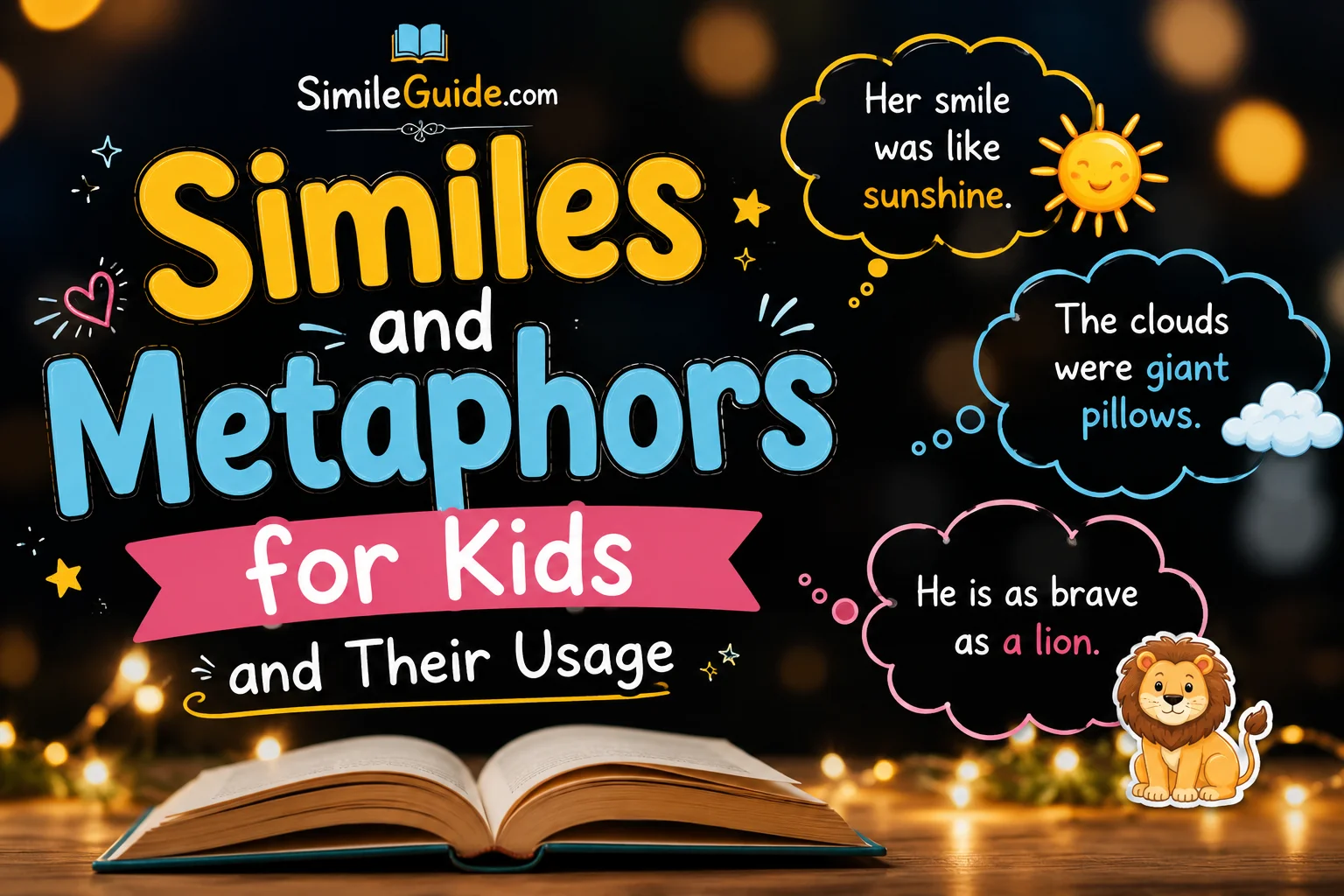
Learning similes and metaphors for kids can be fun when children see how ordinary ideas can become colorful and imaginative. Instead of simply saying that something is fast, bright, noisy, happy, or difficult, we can compare it with something children already know.
For example, instead of saying, “The boy is very fast,” we can say, “The boy runs like a cheetah.” That is a simile. We could also say, “The boy is a cheetah on the track.” That is a metaphor.
These simple comparisons help children become better readers, writers, speakers, and storytellers. In everyday conversations, people often use similes and metaphors to make their ideas easier to imagine and more interesting.
Updated for 2026, this guide explains similes and metaphors in simple language and provides 40 kid-friendly examples, each with a clear meaning.
What Are Similes and Metaphors for Kids?
What Is a Simile?
A simile is a comparison between two different things using words such as “like” or “as.”
For example:
“The baby is as quiet as a mouse.”
The baby is not actually a mouse. The sentence compares the baby’s quietness with a mouse.
Similes help children create pictures in their minds while reading or writing.
What Is a Metaphor?
A metaphor also compares two different things, but it does so directly without using “like” or “as.”
For example:
“The classroom was a zoo.”
The classroom is not literally a zoo. The metaphor means that the classroom was noisy, busy, or difficult to control.
Why Should Kids Learn Similes and Metaphors?
Learning these literary devices can help children:
- Make writing more interesting
- Describe feelings clearly
- Improve creative writing
- Understand stories and poems
- Build vocabulary
- Express ideas imaginatively
- Become better readers
- Write stronger essays and stories
How Do Similes and Metaphors Work?
Similes and metaphors work by connecting an unfamiliar idea with something familiar.
A child may not know how to describe a very loud sound. Instead of saying only “It was loud,” they can write:
“The music was as loud as thunder.”
The child has created a comparison that most readers can understand immediately.
A metaphor can make the same idea even more direct:
“The music was thunder.”
Both sentences create a strong image, but they use different forms.
How a Simile Works
A simile commonly follows this pattern:
Thing + like/as + comparison
Example:
“The clouds were like fluffy pillows.”
The clouds are being compared with pillows because both can look soft and fluffy.
How a Metaphor Works
A metaphor makes the comparison directly.
Example:
“The clouds were fluffy pillows in the sky.”
The clouds are described as pillows to create a vivid picture.
40 Similes and Metaphors for Kids
The following examples are designed to be easy for children to understand. Every example includes a bold example and a bold meaning.
1. As Busy as a Bee
Example: “My sister is as busy as a bee.”
Meaning: She is very active and has many things to do.
This simile compares a busy person with a bee because bees constantly move around while working.
2. Runs Like a Cheetah
Example: “Jake runs like a cheetah.”
Meaning: Jake runs very fast.
A cheetah is known for speed, so this comparison shows that Jake is an extremely fast runner.
3. As Quiet as a Mouse
Example: “The baby was as quiet as a mouse.”
Meaning: The baby was very quiet.
The mouse represents something small and quiet.
4. As Bright as the Sun
Example: “Her smile was as bright as the sun.”
Meaning: Her smile was very cheerful and noticeable.
The sun is bright, so it creates a strong comparison for a happy smile.
5. Like a Rocket
Example: “The boy ran like a rocket when the race started.”
Meaning: He ran extremely fast.
A rocket moves quickly, making it a fun comparison for speed.
6. As Cold as Ice
Example: “The water was as cold as ice.”
Meaning: The water was extremely cold.
Ice gives children an easy mental picture of something very cold.
7. As Hungry as a Lion
Example: “After soccer practice, I was as hungry as a lion.”
Meaning: I was extremely hungry.
Lions are often imagined as strong animals with large appetites, making this a clear comparison.
8. Like a Feather
Example: “The pillow felt soft like a feather.”
Meaning: The pillow felt very light and soft.
A feather provides a familiar image of softness and lightness.
9. As Strong as an Ox
Example: “The athlete was as strong as an ox.”
Meaning: The athlete was extremely strong.
This traditional simile compares strength with the power of an ox.
10. Like a Sleeping Cat
Example: “The kitten curled up like a sleeping cat.”
Meaning: The kitten curled itself into a comfortable, relaxed position.
This comparison creates a gentle picture of a peaceful animal.
11. The Classroom Was a Zoo
Example: “After lunch, the classroom was a zoo.”
Meaning: The classroom was very noisy and difficult to control.
This is a metaphor because the classroom is directly described as a zoo.
12. Her Smile Is Sunshine
Example: “Her smile is sunshine.”
Meaning: Her smile makes people feel happy and cheerful.
The metaphor compares her smile with the warmth and brightness of sunshine.
13. He Is a Walking Encyclopedia
Example: “My brother is a walking encyclopedia.”
Meaning: My brother knows a lot of information.
An encyclopedia contains information, so this metaphor shows that the brother is very knowledgeable.
14. The Snow Was a White Blanket
Example: “The snow was a white blanket across the garden.”
Meaning: The snow covered the garden like a large white covering.
The metaphor creates a clear picture of snow covering the ground.
15. Time Is a Thief
Example: “Time is a thief.”
Meaning: Time seems to take moments away before we realize it.
This metaphor gives time the human-like role of someone who takes something from us.
16. The Baby Is a Little Angel
Example: “The baby is a little angel.”
Meaning: The baby is very sweet, gentle, or well-behaved.
The baby is compared directly with an angel to emphasize good behavior.
17. As Light as a Feather
Example: “The box was as light as a feather.”
Meaning: The box was very easy to lift because it weighed very little.
A feather is extremely light, making it a useful comparison.
18. As Busy as a Bee
Example: “Dad was as busy as a bee before the party.”
Meaning: Dad was working hard and doing many things.
The bee represents constant activity and work.
19. Like a Fish in Water
Example: “Mia swims like a fish.”
Meaning: Mia swims very naturally and well.
Fish are comfortable in water, so this simile shows that Mia is a strong swimmer.
20. As Fast as Lightning
Example: “The runner was as fast as lightning.”
Meaning: The runner was extremely fast.
Lightning happens almost instantly, making it a powerful comparison for speed.
21. The Moon Was a Silver Ball
Example: “The moon was a silver ball in the night sky.”
Meaning: The moon looked round and bright like a silver ball.
This metaphor helps children imagine the appearance of the moon.
22. Her Voice Was Music
Example: “Her voice was music to my ears.”
Meaning: Her voice sounded beautiful or pleasant.
The metaphor compares a pleasant voice with enjoyable music.
23. As Red as a Rose
Example: “His cheeks were as red as roses.”
Meaning: His cheeks were very red.
Roses provide a familiar image of a bright red color.
24. As Gentle as a Lamb
Example: “The little girl was as gentle as a lamb.”
Meaning: The girl was very kind, soft, and careful.
A lamb is often associated with gentleness and innocence.
25. Like a Tornado
Example: “The children rushed into the playground like a tornado.”
Meaning: The children moved quickly and energetically.
The tornado represents fast, powerful movement.
26. The Stars Were Diamonds
Example: “The stars were diamonds scattered across the sky.”
Meaning: The stars looked bright and sparkling.
The metaphor makes the night sky seem beautiful and magical.
27. As Slippery as a Fish
Example: “The wet ball was as slippery as a fish.”
Meaning: The ball was very difficult to hold.
A fish is slippery, making it an easy comparison for something hard to grip.
28. His Room Was a Disaster Zone
Example: “After the party, his room was a disaster zone.”
Meaning: His room was extremely messy.
This metaphor compares a messy room with a place that has experienced serious destruction.
29. As Happy as a Clam
Example: “She was as happy as a clam after winning the prize.”
Meaning: She was extremely happy.
This is a traditional English simile for someone who is very pleased.
30. The Test Was a Monster
Example: “That math test was a monster.”
Meaning: The test was extremely difficult.
The metaphor makes the difficult test sound like a powerful creature.
31. Like a Whisper in the Wind
Example: “His voice was like a whisper in the wind.”
Meaning: His voice was very soft and difficult to hear.
The comparison creates a quiet and delicate image.
32. As Warm as Toast
Example: “The blanket was as warm as toast.”
Meaning: The blanket felt very warm and comfortable.
Toast gives readers a familiar image of warmth.
33. The Classroom Was a Beehive
Example: “The classroom was a beehive before the school play.”
Meaning: The classroom was full of activity and excitement.
A beehive is busy with movement, so the metaphor describes an active classroom.
34. As White as Snow
Example: “The puppy was as white as snow.”
Meaning: The puppy was extremely white.
Snow is a familiar example of something bright white.
35. Her Eyes Were Stars
Example: “Her eyes were stars shining in the darkness.”
Meaning: Her eyes looked bright and beautiful.
The metaphor makes the eyes seem bright and sparkling.
36. Like a Drum
Example: “His heartbeat sounded like a drum.”
Meaning: His heartbeat was loud and steady.
A drum produces a strong beat, making it a useful comparison for a loud heartbeat.
37. The Wind Was a Whistling Ghost
Example: “The wind was a whistling ghost outside the window.”
Meaning: The wind made strange, soft, or spooky sounds.
This metaphor gives the wind a mysterious and imaginative identity.
38. As Hungry as a Wolf
Example: “After the long hike, we were as hungry as wolves.”
Meaning: We were extremely hungry.
Wolves are associated with strong appetites, so the comparison emphasizes hunger.
39. The Ocean Was a Blue Blanket
Example: “The ocean looked like a giant blue blanket.”
Meaning: The ocean appeared wide, smooth, and blue.
This comparison helps children visualize the huge surface of the ocean.
40. Books Are Windows
Example: “Books are windows to new worlds.”
Meaning: Books allow us to discover new ideas, places, people, and experiences.
This metaphor shows how reading can open our minds to different worlds.
Examples of Similes and Metaphors in Everyday Life
Children hear figurative language in everyday conversations more often than they may realize.
Parents might say:
“You are as busy as a bee today.”
A teacher might say:
“Our classroom is a beehive of activity.”
A child might say:
“My backpack is as heavy as a rock.”
These comparisons make ordinary conversations more expressive.
At School
“The test was as easy as pie.”
This means the test was very easy.
At Home
“My little brother is a tornado.”
This means the brother is energetic, active, or causing a lot of movement.
During Sports
“She runs like lightning.”
This means she runs extremely fast.
While Eating
“I am as hungry as a wolf.”
This means the person is extremely hungry.
Famous or Popular Examples of Similes and Metaphors
Some comparisons are commonly used in English and are easy for children to recognize.
“As Busy as a Bee”
Meaning: Very busy or active.
“As Cold as Ice”
Meaning: Extremely cold.
“As Fast as Lightning”
Meaning: Extremely fast.
“Like a Fish in Water”
Meaning: Very comfortable or skilled in a particular activity.
“The Classroom Is a Zoo”
Meaning: The classroom is noisy, crowded, or difficult to control.
“Time Is a Thief”
Meaning: Time passes quickly and seems to take moments away.
These examples are useful starting points, but children should also be encouraged to invent their own comparisons.
Similes and Metaphors vs. Related Concepts
Understanding the differences between literary devices makes figurative language easier for kids.
| Literary Device | Example | What It Does |
|---|---|---|
| Simile | “She runs like the wind.” | Compares using like or as |
| Metaphor | “She is the wind.” | Makes a direct comparison |
| Personification | “The wind whispered.” | Gives human qualities to something |
| Hyperbole | “I have told you a million times.” | Uses exaggeration |
| Idiom | “Break a leg.” | Uses a phrase with a special meaning |
Simile vs. Metaphor
The easiest way for children to remember the difference is:
Simile = uses like or as.
Metaphor = makes the comparison directly.
For example:
Simile: “The moon is like a silver ball.”
Metaphor: “The moon is a silver ball.”
Simile vs. Personification
Personification gives human qualities to non-human things.
Personification: “The flowers danced in the wind.”
Flowers cannot actually dance like people. The sentence gives them a human action.
Simile vs. Hyperbole
Hyperbole is deliberate exaggeration.
Hyperbole: “My backpack weighs a thousand tons.”
The backpack does not really weigh a thousand tons. The speaker exaggerates to show that it feels very heavy.
How to Use and Create Similes for Kids
Children can create their own similes by following a simple process.
Step 1: Choose Something to Describe
Start with an ordinary object, person, animal, or feeling.
For example:
- A friend
- A dog
- A classroom
- The weather
- Food
- A game
- A book
Step 2: Think of a Similar Quality
Ask what you want to describe.
Is it:
- Fast?
- Slow?
- Loud?
- Quiet?
- Bright?
- Dark?
- Strong?
- Happy?
- Sad?
- Soft?
Step 3: Find Something That Has the Same Quality
For example, if something is fast, think about:
- Lightning
- A cheetah
- A rocket
- The wind
Step 4: Use “Like” or “As”
Create the simile.
“The dog runs like a rocket.”
Or:
“The dog is as fast as lightning.”
Step 5: Create a Metaphor
Now remove the comparison word and make the description direct.
“The dog is a rocket.”
This creates a metaphor.
Easy Simile and Metaphor Activities for Kids
Learning figurative language becomes more enjoyable when children practice it through activities.
Fill in the Blank
Ask children to complete:
“The sun is as bright as ______.”
Possible answer:
“The sun is as bright as a diamond.”
Make a Simile
Give children an ordinary sentence:
“The boy is fast.”
Ask them to turn it into a simile:
“The boy runs like a cheetah.”
Turn a Simile Into a Metaphor
Start with:
“The classroom is like a zoo.”
Change it to:
“The classroom is a zoo.”
Picture Comparison
Show a picture of a cloud and ask:
“What does this cloud look like?”
Children might answer:
“It looks like a fluffy pillow.”
Creative Writing Challenge
Ask students to write five sentences using:
- One simile about an animal
- One simile about food
- One metaphor about school
- One metaphor about friendship
- One simile about weather
Common Mistakes Kids Make With Similes and Metaphors
Mistake 1: Forgetting “Like” or “As” in a Simile
A child might write:
“The boy is a cheetah.”
That is a metaphor, not a simile.
For a simile, write:
“The boy runs like a cheetah.”
Mistake 2: Thinking the Comparison Is Literal
When we say:
“The classroom is a zoo,”
we do not mean that real animals are sitting in the classroom.
It means the classroom is noisy, busy, or chaotic.
Mistake 3: Mixing Similes and Metaphors
A child may write:
“The girl is like a shining star.”
This is a simile.
If they write:
“The girl is a shining star,”
it becomes a metaphor.
Mistake 4: Using an Unclear Comparison
A comparison should have a logical connection.
“The boy is like a pencil because he is fast.”
This is confusing because pencils are not normally associated with speed.
A better comparison is:
“The boy runs like lightning.”
Mistake 5: Making Every Sentence Figurative
Children do not need a simile or metaphor in every sentence.
Good writing combines figurative language with clear, direct sentences.
Why Similes and Metaphors Are Important for Kids
Learning figurative language gives children more ways to express their thoughts.
They Improve Creative Writing
A story becomes more interesting when children write:
“The moon was a silver ball hanging above the trees.”
instead of simply:
“The moon was in the sky.”
They Improve Reading Skills
Children who understand similes and metaphors can better understand poems, stories, songs, and other forms of writing.
They Build Vocabulary
Figurative language encourages children to think about different words and relationships between ideas.
They Encourage Imagination
A child who compares clouds to pillows is practicing creative thinking.
They Make Writing Memorable
A sentence such as:
“Her smile was sunshine”
is more vivid than:
“She smiled happily.”
Using Similes and Metaphors in Essays, Poems, and Stories
In School Essays
Children can use similes to make descriptions stronger.
“The playground was as noisy as a stadium.”
Meaning: The playground was extremely loud and busy.
In Poems
Metaphors can create beautiful images.
“The moon was a silver lantern in the sky.”
Meaning: The moon looked bright and glowing against the dark sky.
In Stories
Similes can help readers imagine characters.
“The little boy ran like a rabbit when he heard the dog.”
Meaning: The boy ran very quickly.
In Captions and Social Media
Simple comparisons can make captions fun.
“Best friends are like stars—you do not always see them, but they are always there.”
Meaning: True friends remain important even when they are not physically nearby.
Tips for Teaching Similes and Metaphors to Kids
From real-life writing experience, children learn figurative language more easily when examples are connected to things they already know.
Use familiar subjects such as:
- Animals
- Food
- Sports
- School
- Family
- Weather
- Toys
- Technology
- Friends
- Nature
Start with simple comparisons before introducing more poetic metaphors.
For example:
Easy: “The baby is like a kitten.”
More creative: “The baby is a tiny bundle of sunshine.”
The goal is not to make every sentence complicated. The goal is to help children understand how comparisons can make language more expressive.
Suggested Internal Links for Related Topics
If you are publishing this article on an educational or literary website, useful internal links could include:
- What Is a Simile?
- What Is a Metaphor?
- Simile vs. Metaphor
- Examples of Similes for Students
- Examples of Metaphors for Kids
- Figurative Language Examples
- Personification Examples for Kids
- Hyperbole Examples for Students
- Simile Activities for Grade 4
- Simile and Metaphor Poems for Kids
These related topics can help readers continue learning about figurative language.
Frequently Asked Questions
What is a simile for kids?
A simile compares two different things using words such as “like” or “as.” For example, “The boy runs like a cheetah.”
What is a metaphor for kids?
A metaphor compares two things directly without using “like” or “as.” For example, “The boy is a cheetah on the track.”
What is the easiest way to remember a simile?
Remember that a simile usually uses “like” or “as.”
For example:
“The snow is as white as cotton.”
What is the easiest way to remember a metaphor?
Remember that a metaphor makes a direct comparison.
For example:
“The snow is a white blanket.”
Why should kids learn similes and metaphors?
Similes and metaphors help children understand reading, improve creative writing, expand vocabulary, and express ideas in imaginative ways.
Conclusion
Similes and metaphors for kids are simple but powerful tools for making language more creative. A simile compares things using “like” or “as,” while a metaphor makes a comparison directly.
Children can find these literary devices in stories, poems, conversations, classroom activities, captions, and everyday descriptions. The more they practice, the easier it becomes to recognize and create them.
Encourage kids to look around and make their own comparisons. A cloud can become a pillow, a smile can become sunshine, and a busy classroom can become a beehive. With a little imagination, ordinary sentences can become much more colorful and memorable.
DISCOVER MORE ARTICLES
Simile for Taking a Long Time: Examples and Meanings 2026
Simile for Later School Start Times: 40 Examples 2026
Simile for Complicated: 40 Creative Examples and Meanings 2026
